



DxOmark sensor test: A77 is as good as Nikon and Canon fullframe cameras!

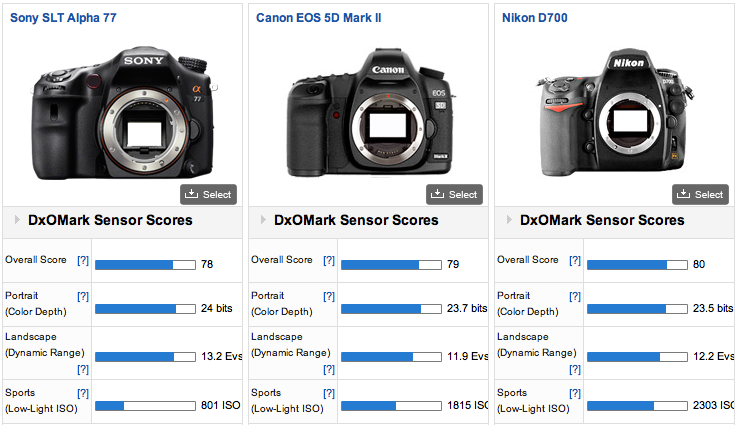
DxOmark (Click here) just published an extremely interesting Sony A77 sensor test. The A77 sensor has a very large Dynamic range that easily suprasses the results of the Nikon D700 and Canon 5D markII fullframe cameras: “In conclusion, thanks to its capacity to innovate always further and to break the limits of sensor design, Sony is about to bring on the market a very good semi-professional camera body. The next question is the capacity of the lenses to address the challenge of these very small pixels. The DxOMark lens measurements should give us an answer very soon. Last but not least, as the same sensor will be used by the Sony A65 and the Sony NEX 7, we should see some nice reviews very soon. It will be especially interesting to see the NEX 7 results as it doesn’t feature a translucent mirror and should take full advantage of this amazing sensor.”
The real surprise is that the Sony A580 sensor has a similar A77 score. because at High ISO it’s still noticeable better (Click here to see the comparison). I confess I am now very intrigued about how good the Sony NEX-5n can be. And of course as DxOmark said, I expect the Sony NEX-7 to be a tack better than the A77 because of the absence of the semitransparent mirror.
Now it’s up to you to preorder the right camera. I give you the links to all of them ![]()
A77 at Amazon, Adorama, B&H, J&R, eBay.
A65 at Amazon, Adorama, B&H, J&R, eBay.
Sony NEX-7 Amazon, Adorama, B&H, J&R, eBay.
Sony NEX-5n Amazon, Adorama, B&H, J&R, eBay.
Zeiss 24mm f/1.8 Amazon, Adorama, B&H, J&R, eBay.
Sony 50mm f/1.8 Amazon, Adorama, B&H, J&R, eBay.
Sony 55-210mm Amazon, Adorama, B&H, J&R, eBay.
NEX-5n viewfinder Amazon, Adorama, B&H, J&R, eBay.

Rodrigo
8 months ago |This a hideous ISO1600 pic, it’s even a straight jpeg.
http://www.flickr.com/photos/sportsphotorob/6089598155/
And this ISO6400 monstrosity should be made illegal, the noise is horrible!!! Is is a guy playing the sax or a seagull with a smartphone?
http://www.flickr.com/photos/sportsphotorob/6090134836
I hope my A77 is terrible like this one.
Sporeo
8 months ago |haha I think you are joking, but here are some more high ISO pictures for people to complain about, all between 1600-3200 =P
http://www.flickr.com/photos/jim-lin/6158244998/sizes/l/in/photostream/
http://www.flickr.com/photos/jim-lin/6158150596/sizes/l/in/photostream/
http://www.flickr.com/photos/jim-lin/6158115752/sizes/l/in/photostream/
So awful, right? Man, I can’t wait to take crappy pictures with my a65!
Marek
8 months ago |I’m dissapoited by ISO performance of A77 too. But after some thinking I realized that the performance is in practice almost the same among all APS-C CMOS sensors regardless of Mpx if compared on the same output image size (prints, screen size). It means that it is sensitivity of CMOS material what defines ISO performance. I can see lack of progress (or very low progress) in that in recent 4 years. DXO data proves it. So we should not complain about 24Mpx in A77. It give us more resolution in good light. If SONY was not able to improve CMOS sensitivity significantly over 4 years, other manufactures will not be able too. Only options we have for now is to go FF if we want 2 times better ISO sensitivity (2.5 times without translucent mirror). Hawk.
Rodrigo
8 months ago |Yup, they look like the VGA pics from my 5 year-old cell phone.
Can you imagine a PROFESSIONAL trying to use those pictures??
Jokes aside, I see that in high ISO scenarios the A77 is very good but not the best (especially when compared to FF). I’m perfectly OK with that.
coolpix990wascool
8 months ago |Hi folks,
I’m a person who does fotography mainly as a hobby (though quite passionately) and to me it seems a lt that people complaining about high ISO performance mainly are. Why? Well, probably they have to justify to their significant other spending a hell lot of money on equipment (or just can’t afford) and therefore want to buy a single camera for every purpose and not carry around plenty of lenses, tripods, flashes. With the latter there’s also the issue that they might annoy people by using a flash frequently or simply aren’t allowed to do so. But one of the key mistakes seems to be reading DxOmark results to justify a camera rather than investing in fast lenses! Otherwise they’d understand that “Sports” is the right title/scenario where high ISO performance really matters.
If you do pictures of concerts for a living, you certainly are allowed to shoot from front row or on stage – take a f/1.4 prime and you want need much more than ISO 1600 … and nobody would criticize you for a bit of flash to freeze some action. But as a hobbyist, you frequently don’t get close enough to abandon zoom (and you won’t invest in an arsenal of non-zoom telephoto lenses and also not spend 2000+ on a f/2.8 zoom), so we have something like a f/3.5-5.6 (kit) zoom and know that flash won’t help at this distance … similar to what sports and wildlife photographers have to deal with – only that they do invest the money in fast telephoto lenses. Hobbyist concert photography is when you need high ISO – but this is also where I personally would be much more concerned about an excellent LiveView mode on a tiltable/articulated screen: You are several rows away from the action, need to shoot overhead and can’t use any viewfinder.
And this was the main reason why I got an A350 in first place and then switched to an A580 and would consider buying a A77: They LiveView handling is just so much better than with anything I’ve seen and tried from Canon or Nikon. Nikon had great overhead handling of a camera long time ago – with the compact camera series Coolpix 950/990/995/4500, but that sophistication never translated into their DSLR designs (mainly for technical reasons), the D5000 articulated screen is no comparison in handling. Canon has articulated screens with the 60d / 600d / 1100d, but that only supports well video recording by placing them to the left side of the camera … when in shooting photos your left hand should actually control and stabilize the lens and your right hand should always remain on the trigger. So Sony is in my opinion the best choice – and that’s why some people may see it as a pity that high ISO comes at the cost of high noise. Nevertheless, for me, the better handling outweighs by far the noise – but handling is much harder to put into “hard numbers/facts” as high ISO performance as DxOmark does.
Other categories mentioned: at weddings, my A580 performed in general very well – except sometimes for focusing. And here the package of a f/2.8 16-60 lens with the A77 could certainly outperform my combination of a Zeiss f/3.5-5.6 16-80 with the A580 … and a Sigma 50mm f/1.4 which had most trouble in focusing due to the narrow DOF; so having an SLT with much more cross sensors could be a great benefit. And in line with Clyde’s experience: Even when I was concerned about all the noise I saw very well on my 27 inch iMac, nobody ever complained about that noise – it just didn’t matter to anybody else than me.
Nawaf
8 months ago |I read your first paragraph and then I just got bored because it was just too long.
About concert shooting, people who shoot concerts have a favorite weapon of choice, the D3S which is usually paired to the 70-200 2.8 VR. They do shoot at up to ISO 6400 and never use flash unless they want to get kicked out.
I would prefer to catch the mood that the lighting director is trying to convey to us and not use flash even if I could.
Nawaf
8 months ago |Does anyone use an APS-C camera to shoot concerts? I’m just curious.
sholky
8 months ago |Yes, ofcourse, if you don’t have anything else.

I shot somewhere about a hundred concerts in the last two years, and I did a lot of them with my old A300 with which I can’t go above ISO 400.
So, it’s possible, but it’s also very difficult.
And the thing about A77 is, there are a lot of us who need good high ISO, and there are very few of us who need 24mpx.
The new Sony APS sensor is simply worse than the old one in every way except for the mpx number, and that’s just, well, stupid.
Dave Cox
8 months ago |Stupid, stupid comment.
If you don’t need 24MP at high ISO then rescale the image to 12MP. You will find the noise miraculously improves then too.
Why are people comparing noise performances of different size images? Annoying, pointless and a waste of time.
alphafan2011
8 months ago |Well you are wrong, Then noise then reduces a little bit, yes … BUT you cant compare it. Because thanks to less light on the smaller pixels of the 24 MP sensor, Sony tries to compensate it with a lot of smearing noise reduction … and if you then rescale the resolution, you have LESS DETAIL! Fact!
Steve Jones
8 months ago |None of the music venues in London where I’ve had photo passes have allowed photographers to use flash on live performance. It’s simply not allowed at any of the medium/larger venues. In general, flash on live performances looks horrible as it tends to wipe out the atmosphere. You also tend to get beautifully illuminated stage furniture – which you generally don’t want as the typical musical stage looks like a junk shop.
Of course there tend to be lot of little flashes from the audience using compacts and mobile phones (as the organisers long ago gave up on banning them), but they are so far back that they don’t disturb the performers – or for that matter do much good as they are too weak. I know of no large London venue that will allow DSLRs into the audience (you might get away with an NEX provided the lens isn’t very big). That would also go for carrying around a large flash gun.
There are a whole bunch of smaller venues in London where amateurs can (normally) take a DSLR, but even then etiquette prevails and a flash gun is a way of courting unpopularity.
Far and away the most important thing about live performance photography of music and theatre is stage lighting. Given that photographers generally have precisely zero say in that, it’s the high ISO performance and appropriate lenses that make the difference. In general, it’s dynamic range at high ISO that really matters – stage lighting tends to have large contrast ranges.
As for f1.4 primes, I do use one of those, but the DoF at f1.4 at close quarters is narrow. At 5 metres, and a rather coarse CoC of 0.02mm, it’s about 50cm. However, if you want a CoC more appropriate to digital resolution, you are looking at about 20 centimetres of DoF. That’s fine for nice arty photos where you have an important single focus point, and the rest of the image blurred. Also, in a typical photographers “pit” you tend to be shooting up at a fair angle so you pretty well never get the chance for a direct head-on at performer level (at least in a venue with a raised stage). In general, very wide aperture shots are of limited use in my experience – most of my performance shots are taken at f2.8 with only a very few at f1.4.
I’m afraid that there’s no substitute for sensor size and high-ISO in these circumstances. Ultra-wide aperture lenses impose DoF limitations – they have their uses. Flash is an absolute no-no for artistic, atmosphere and disturbance reasons.
We are nearing the theoretical limits of sensor technology. Already the QE of the latest APS-C sensors is up around the 50% mark. Much of the read noise is limited, and if any manufacturer manages another stop improvement in sensor performance I’d be amazed.
So if you want really high ISO then you want to get rid of that SLT mirror and go FF. Maybe an FF version of the E-Mount might be that answer, if they can get AF working well enough.
Pascal645
8 months ago |Very true but how large do you need to print? The Nex7 without the mirror should be up to ISO1200 in DXO parlance, and binned 2×2, you’d be up to almost 5000. Still left with 6Mpx, well enough for a 15 inch spread. Is that enough or do you need larger prints?
Steve Jones
8 months ago |I could usefully use up to ISO 6400, but it’s the dynamic range that’s the issue. Generally there’s always a bit of cropping to do. At ISO 6400, the Nikon N3S is giving almost 9.2 stops of DR whilst the A580 has about 7.7 (standardised to 8MPox). I expect the NEX-7 to be similar to the A580 in this regard. To get back that 1.5 stops of difference, the A580 image would have to be reduced to perhaps 3MPiX (before any cropping).
Actually my biggest problem these days is LED lighting. Some stage lighting managers seem to love using dominantly red LEDs. Unfortunately, quite apart from colour balance, bayer-pattern sensors are biased towards sunlight with twice as many green filtered photosites as either red or blue. In consequence, you can end up with only one in 4 photosites providing significant image information. My 12MPiX camera ends up as 3 MPiX, and even the last resort B&W conversion can only help so far.
With traditional lighting (even filtered lighting) this was never quite so bad as there wasn’t the sudden spectral cut-off you get with LEDs. Fortunately LEDs aren’t (yet) up to lighting really big stages, but it’s coming.
Pascal645
8 months ago |Very interesting, I had no idea! The Sonys clearly aren’t the best tools for those conditions! Good luck
Steve Jones
8 months ago |@ Pascal645
Problems with photographing under LED stage lighting is absolutely nothing to with the make of camera. All digital cameras have the same issues. Here, for instance, is a thread in a Pentax forum
http://www.pentaxforums.com/forums/pentax-dslr-discussion/93809-modern-led-stage-lighting-photography-problems.html
coolpix990wascool
8 months ago |Thanks for your comment. A bit on DoF: agree, f/1.4 is very narrow – but it’s significantly more narrow on FF than on APS-C. If it’s too narrow, stopping anywhere down to f/2.8 still offers advantage to where zooms would be.
FF with E-Mount: I’d guess AF would not be the only problem – none of the current E-Mount would work without excessive vignetting. So either somebody releases a bunch of heavy, expensive new lenses only for FF use, or an FF NEX would only be usuable with adapter and A-Mount or other FF lenses.
azimuth
8 months ago |the result from DxOMarks are pretty clear: the A77 is significantly inferior to Nikon D7000 and Pentax K5 in all the things that really matters!
Color depth is just a bit better but both the dynamic range and the low-light ISO capabilities are much worse than the Nikon’s and Pentax’s ones.
So in the APS top class compart the Sony A77 scores worse than its competitors. It did better only with camera that are 2 y/old or older.
I guess that what we have suspected since the annouce is true: 24MP are too many!
loverhd
8 months ago |A77 get a bigger score only because of the ISO 50.
Starting from the ISO 100 it shows exactly the same results as A35.
So the new 24MP sensor gives exatly the same results in noise, dynamic range and color sensitivity as 3 year old 16MP sensor, which is inside D7000 also.
As the translusent mirror eats up almost half a stop, A77 looses D7000 in sensitivity, dynamic range, color sensitivity about hal a stop.
saiman
8 months ago |I was waiting for these results…. thanks for posting.
I’m sad though…. and I can see that many couldn’t swallow the failure of Sony in delivering a better quality sensor.
I was also reserving my comment untill I see the final results, and couldn’t believe earlier that Sony would actually fail so miserably.
Sadly, the 24MP sensor is just a disgrace.
It is clear now why A77 and Nex-7 were packed with so many awesome features…. Sony needed some reason to sell these two cameras despite this crappy sensor.
I feel that Sony knew from beginning that they cannot improve anything within the APS-C size over what they achieved with the 5n sensor.. However, since they promised improvement over the competition (D7000 was already out then), they simply decided to reduce the size of the photosites and cramp up 24MP within the APS-C size. Knowing how horribly it affects the photos, they decided to add all the cool features to the A77 and Nex-7 cameras.
A77 achieved a legendary status online from all the anticipation. And Sony’s promise of adding the coolest features and rumors added more to its wide publicity. So, I know many will still buy it… However, in the end.. A77 is a photographing tool that does not take good enough photos in challenging conditions.
Just look at the samples…. traces of noise show up even at ISO 400 losing significant details… This is just unacceptable for a semi-pro camera of today.
Downsampling a noisy picture to reduce noise can be a workaround to save the images, but to say it would be as good as the 16MP images from a 5n sensor is utter ignorance…
To explain briefly…. A 16MP sensor records the 16MP resolution from the real-life environment using the analog light source (noise free)… So, when the 16MP images are noise free, each pixel retains the color that is the closest to real world recorded by the sensor…. Now, a noisy 24MP image is already in the digital form and has distorted significant color information during the processing with added noise and hot pixels… Now, downsampling that 24MP image to a 16MP one may make noise hard to perceive, but the image quality would be much lower than the 16MP images captured from the original environment using the analog light source.
Steve Jones
8 months ago |@saiman
So many words, so many misconceptions, so little understanding…
Just to pick up a couple of fundamental errors in the last paragraph alone. Light is not an analogue source – it’s quantised. Secondly, no light source can be “noise free” due to that very quantisation. Noise is fundamental to the nature of light because of a statistical effect called “photon shot noise”.
Thirdly, it makes not one jot of difference if the downsampling is done by having larger photosites that receive more photons or if it is performed in the digital domain, provided that read noise in the electronics is well controlled (which is is on the current generation of Sony sensors).
The fact is, if you took a high-ISO RAW photo from an A77 and one from an A55, and downsampled the former to 16MPiX with equal processing (colour, sharpening etc.) and examined the output and didn’t know which was which you would almost certainly not be able to determine the difference (just possibly the A77 would be preferred as the higher spatial frequency of colour sampling helps, even after downsampling).
ShamB
8 months ago |@Saiman
If you were waiting for these results, why didnt you bother to read them to the conclusion: ‘Sony A77: a very good semi-professional camera’?
Accoring to DXO, Low ISO is the ONLY thing (including price) that the 5D II and D700 really beat the a77 on.
Jonathan
8 months ago |Wow Saiman, you are one very disappointed person by the sounds of things, and it seems you are kind of reading into things incorrectly perhaps? When you say the new sensor is a ‘disgrace’, ‘crappy’, ‘failure of Sony’..etc..etc. What you are referring to is the LESS than half a stop compared to the top performing camera correct? You seem to forget you have around 50% more resolution, a SLT design (which is around 1/3 to 2/3 stops less light in its self to what you are comparing it to)… So on those two points alone this to me means this must be the most advanced sensor out of any currently available on the market!
As you mention the camera also features a very wide range of ‘extra’ features/tools that will aid you in low light… Also down sampling is possible and acceptable practice to perform a more accurate comparison. Another thing to keep in mind is even with your argument of total and utter disappointment in Sony from being an underdog in the industry they sure seem to be shaking things up and growing in market share. What I would suggest is if you don’t like the A77 simply to not buy it and go and buy your D7000 if that’s what makes you all hot and sweaty under the collar.
From what I’ve read and seen with this sensor it is by far one of a significant achievement and some are even comparing it to full frame sensors on the low ISO (again this is not ‘fair’ and should not be done BUT it’s producing some amazing results!)
david safier
8 months ago |I care more about dynamic range then iso. I would like to see a 20mp ff camera that shoots iso1600. And shoots 16bit images at 12 stops of light. Like medium format cameras. If they can do it with medium format 80mp sensors why can’t sony do it with 20mp chip.
Steve Jones
8 months ago |@david safiier
It’s quite simple, an MF camera has a much larger sensor surface. The Phase One P65 Plus has about 2,180 sq mm surface area versus about 380 sq mm for the A77. That’s approaching 6 times larger and, in consequence, can collect 6 times as many photons (for common technology levels). That alone is worth 3 bits.
Also, bear in mind that not all those 16 bits contain useful data. The P65 plus has a peak dynamic range of 13 stops. That basically means that, out of those 16 bits, the last 3 contain nothing useful. It’s simply digitised noise. (In fact it’s a bit worse than that – the 13 stops is after downsizing to 8MPiX, thus the useful content on a per-pixel basis is less than 12 bits).
Note that at higher ISOs those extra bits are wasted anyway as more and more bits contain useless information due to the noise floor increasing as gain is wound up.
doug
8 months ago |Sony’s semi-translucent mirror technology is a failure. It wasn’t needed by anyone and it degrades image quality. The NEX-7 will have better IQ than the A77 because it won’t be crippled by a semi-translucent mirror that reduces the amount of light that reaches the sensor. If Sony has any sense they’ll abandon STMs and go back to regular mirrors.
Rodrigo
8 months ago |I disagree. If Sony wants to get big into de DSLR market it will not be able to do it with traditional SLR technology and without maasive investments that it doesn’t want to do.
Therefore it has chosen to go in a different direction with STM. The SLT line is fewer than 2 years old, both for the good (speed, continuous AF) and the bad (1/2 stop loss). They can only get better.
Even if SLT proves to be a failure (highly unlikely) they would never go to SLR but rather mirrorless, in the NEX direction.
doug
8 months ago |I agree that if Sony doesn’t want to return to a more traditional SLR with a mirror then they should concentrate on mirrorless cameras, because with their current crop of STM bodies they’re actually going backwards in terms of image quality. And high ISO performance isn’t nearly as good as it should be. I hope that they don’t screw up the FF successor to the A900 by giving it the same STM as the A77.
Jonathan
8 months ago |Well I guess at the end of the day it all depends what you are after out of the camera, if you are printing bill boards you should not be shooting with an APC camera in the first place. If you are printing your pictures or viewing them on your 50” LCD TV you will not notice any difference at all between STL and SLR. If you are a pixel pepper (which we all do at times) yes there is slight (and I mean very slight) decrease in performance but it’s hardly worth even talking about as it’s not even 0.5 stops worth of difference when compared… Also if you compare it to the most sold camera (being the Canon) Sony is already ahead of them with APC even with the SLT technology AND 24MP packed into the new APC sensor! So from an underdog company to be already getting ahead of Canikon and having growth in there market I think they are doing very well and must be doing something right!
Dave Cox
8 months ago |@Doug.
Such a broadbrush, nonsensical comment.
You take into account all of the drawbacks and none of the benefits.
My mate and I do a lot of landscape work – he has a Nikon D7000 and because he can’t see the final image effect on his LCD (I can see it on my A55 EVF) he has to re-shoot so often while I have exposed perfectly.
You, sir, are a troll.
Jonathan
8 months ago |Hi Dave,
You make a very good point most people complaining only seem to focus on what is really LESS that 0.5 stops less performance when compared to what is currently the highest scored APC camera, this really not NOT much of an issue and is a great achievement when looking that the SLT technology alone can have take upto 2/3 of a stop AND you have a new sensor that captures 50% more MP that before… Also as you say the other features/bells and whistles that come with this camera are amazing yet people only are focusing on the single slight (less than 0.5 stops, slight) negative. If you guys don’t like the A77 simply do not get it, no one is forcing you to, in fact go buy the Nikon D7000 but THEN do not complain that it does not offer all the features the A77 does… end of the day you chose the camera that will suit your needs if that is the A77 or D7000 all the best to you with which ever you chose I personally think they are both great camera’s but I’m leaning towards the A77 for my needs.
doug
8 months ago |@Cox – Fact: Sony’s STM degrades image quality. Fact: any lens you put on the A77 instantly becomes 1/3 to 1/2 stop slower because of STM light loss. I’m not a troll, you’re a fanboi who can’t deal with the fact that Sony screwed up. End of story.
alphafan2011
8 months ago |as a result we can say, Sony does everything right to look good in benchmarks and tests thanks to the move to add Iso 50
If you look at Iso 400 or 800 (no, it doesnt have to be 6400), the A77 is definately outperformed by the D700 and 5D MkII easily in Color depth AND in dynamic range!
also the signal/noise-ratio shows that the A77 has no chance in EVERY ISO!
So we see, the A77 gets its good result only because of the good Iso 50 perfomance, all above that gets worse very fast.
if you wanna look for yourself (go to “measurements” and look at every result in all ISO’s): http://www.dxomark.com/index.php/Cameras/Compare-Camera-Sensors/Compare-cameras-side-by-side/%28appareil1%29/734|0/%28brand%29/Sony/%28appareil2%29/483|0/%28brand2%29/Canon/%28appareil3%29/441|0/%28brand3%29/Nikon
Jonathan
8 months ago |Alphafan2011, Excuse me but what on earth are you doing comparing full frame camera’s with the Sony A77 which is an APC camera? I would HOPE that a full frame camera that costs twice the price would out perform any APC system. You do realise you are comparing an APC sensor which has around 370mm2 surface area to full frame that is at around 864mm2, which is OVER twice the surface area? I would surely hope it’s dynamic range, ISO and Colour depth are superior! What I would suggest you do is wait for Sony’s new full frame camera next year (?) then compare that with the D700 and 5D if you like to get a more fair comparison. In the mean time compare the A77 to other APC camera’s. My goodness me what is wrong with people? YES the A77 can seem to show GREAT results agains some full frame camera’s but this does NOT mean you can expect it to be better especially with dynamic range, colour depth and ISO, it’s like expecting full frame to outperform medium format, it’s just not fair to expect this.
alphafan2011
8 months ago |well, it wasn’t my comparison, it was the comparison here on SAR?!
so of course that are bigger sensors, I only tried to relativize the results cause its here presented, as if it would be on par or even better at the DXOmark!
but you are right, the best comparison would be with the cheaper contenders from Canikon: http://www.dxomark.com/index.php/Cameras/Compare-Camera-Sensors/Compare-sensors/(appareil1)/734%7C0/(brand)/Sony/(appareil2)/680%7C0/(brand2)/Nikon/(appareil3)/619%7C0/(brand3)/Canon
and what do we see? again Iso 50 makes the good results on A77, everything else is much lower than D7000 and on par and from ISO 400 mostly lower than 7D … and thats only the Color and dynamic range performance, I dont want to look at the noise performance, there its even clearer!
yes, then the arguments come like “it has the additional SLT design with the fixed lens, without the results would be better” … yes, maybe, maybe not, but the lens is there, you cant remove it
Jonathan
8 months ago |Hi Alphafan2011, You are correct the heading of this article can be a little misleading but I think what was trying to be conveyed is that it’s managing to pull of results of some full frame camera’s which is amazing. I think the D7000 and 7D is better camera’s to compare with and both in the same price range (7D being more expensive than the A77 and D7000 slightly cheaper). Also keep in mind if adding a lens the equivalent F2.8 lens in Canikon will make it a significant price increase!
When I look at the results on DxOMark it’s not a HUGE difference and I believe the great advantages of the A77 camera outweigh the slight decreases you are talking about (well for my shooting needs they do any way). I also wonder if all 3x camera’s images are downsized to the same 16MP of the D7000 if the results will narrow down closer together?
DxoMark does calculate the overall score with some of these required conversions and when this is done the A77 is ahead of the Canon 7D but the D7000 still had a very slight edge over the A77 but only just! So when looking at the results in this way it seems to be a very very impressive sensor in this camera, and let’s not forget about the benefits of the SLT technology and other great features the A77 includes that will help you get the shot you want.
I think when looking at the entire ‘package’ of features, results and price this A77 is looking like a great deal and for a new SLR/SLT user it’s a no brainer choice for what you get in value.
Dirk Diggler
8 months ago |As good as FF…. Using DxO Marks…
LOL. Look at ISO values…
DxO does not measure the flexibility of a sensor…
Let’s try to under expose a 400ISO 14bit CRW or a NRW and do the same with A77 ARW…
Bye Bye…
alphafan2011
8 months ago |well dont know how the prices are in your country, but in Germany the A77 is by far the most expensive, the D7000 ist 2/3rd of the A77-price (http://geizhals.at/deutschland/?cmp=458190&cmp=569825&cmp=675394#xf_top)
yes, an F2.8 lens makes every body more expensive … but probably the A77 will only work with high end lenses, while the D7000 and the 7D will also work with (only) good lenses, because only high end glasses can feed the small 24 million pixels with enough light!
yes, its not a huge gap, but the A77 is under its rivals, which also are cheaper. if you prefer 12 fps burst for one second or maybe better continous shooting thanks to Compact flash support is everyones own decision I think … so all have their advantages and disadvantages.
And we also talk only about color and dynamic range, not about noise, which is definately worse on the A77.
And thats not all. Sony has especially at higher isos much of detail loss thanks to the smearing noise reduction, but as a result less “noise” which probably makes the results better than they are…
so we will see, but I don’t know any reason why Sony didn’t choose the really good NEX-5N sensor for the A77?!
it would have so many advantages:
- better high iso performance (low light)
- easier to use not the most expensive lenses
- smaller file sizes
- longer 12 fps burst rate (cause file sizes are smaller and probably in camera procession doesnt last that long)
- less detail loss (Sony does a lot of reduction, even starting at ISO 800 !)
- probably better Color depth and dynamic range
but instead of that Sony chooses the 24 MP with its own advantages like:
well see, bigger resolution isnt always more detail … so why else?
- bigger resolution
- what else?
Rodrigo
8 months ago |Could Andrea please put a sign at the top of the website saying “We know that the pellicle mirror take 1/2 of light and it hurts in high ISO”?
Because apparently no one has noticed it or made it the A77′s death charateristic.
Maybe another banner saying “if you blow an A77 picture to a 60×40 inch size and then get to 5cm of the image it looks worse than other cameras with fewer mpx”?
———-
It’s so bad that nobody could shoot dark images until the 7D, D7000 and 5D.
Rodrigo
8 months ago |Why 24 mpx?
For me, when/if a buy an A77/65 it means more reach for my camera due to more cropping being possible. I can always use more reach.
I just want to see what many will say about “too many mpx” when Canon and nikon get similary-dense sensor nexxt year.
The 60D’s sensor would be 21 mpx if it were the size of the A77′s.
Is 21 also too much?
David
8 months ago |Yawn.. all this measurebating is stupid. Results are as good as any other APS-C camera. And I’ve never had a customer complain about noise anyway. It’s a photographer issue, not a customer issue. And if you’re a hobbyists.. who cares? The handling, design etc are much more important.
Matt
8 months ago |I’m trying to follow along with this discussion of ISO performance, but I have a hard time relating to all these technical specifications. I have a Sony a350, I’m up grading because I need a bit higher ISO performance (now I don’t go higher than 400, so if I could go to 1600 I’ll be thrilled. I want the good video capabilities (60fps P) and that’s about it. Here are some pictures I took with my a350 last night http://www.mediafire.com/i/?hm6sqb35arca2kq
Pretty good eh..? Now with my a77 I’d have had more possibilities of uping the ISO, making my little speed lights more powerful, but honestly, still not really needed. Taking good pictures is up to the photographer, the camera has something to do with it, but less that most people might think.