


Sony A7V preorders:
In USA at at BHphoto, Amazon, Adorama, Henrys.
In EU at Fotokoch, FotoErhardt, Calumet, Foto Köster, WexUK, Clifton, Park UK, Fnac FR.
In Australia at: Camera Pro, Sony Australia.
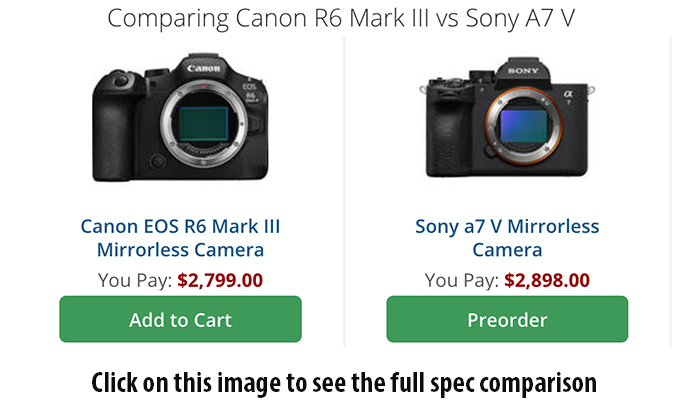
Sony A7V vs Canon R6III (full spec comparison on this BH page)
It’s time to make the big discussion: Sony A7V vs Canon R6III. Now one thing has to be made clear: Both are EXCELLENT cameras and nobody should switch system because of “one” camera. But let’s get into the bitty gritty and highlight the differences between the two
1) Sony’s fundamental architectural advantage:
“The Sony A7V uses a more modern, faster sensor architecture (partially stacked vs. Canon’s non-stacked design) and a newer processor with integrated AI. This gives Sony far more headroom for future features added through firmware updates than Canon currently has. In other words, the A7V has significantly greater upward potential that Sony could — and hopefully will — take advantage of. Any missing features today (such as Open Gate) are, at least on paper, well within the camera’s capabilities. Now we just need to push Sony to actually deliver them.”
this is point nearly nobody highlighted: The Canon is based on a regular architecture while Sony has gone all in with a very future proof hardware.
2) Sony is the king of speed:
The devil is always in the detail: While Canon can read out at 13.5ms and the Sony at 15.1ms, the Sony does it in full 14 bit while Canon has to reduce the amount of data with a 12 bit readout. This allows Sony to have an impressive 1+ stop advantage in dynamic range over the Canon! 40fps in lower quality of the Canon is in my opinion not a match for the 30fps 14bit RAW of the Sony.
3) Sony has the edge in still-image quality:
Sixteen stops of dynamic range sounds impressive, and I’m looking forward to proper tests that can confirm whether Sony’s still-image quality now pulls ahead of Canon.
4) Canon wins in video
Canon has 120p uncropped, Open Gate, waveform, false color, 7k. internal RAW recording. Sony’s only advantage is much less overheating issues. Now, Sony has the margin (speed on the sensor è power on the processor) to improve the video features through future updates. Let’s see if they can close the gap with Canon.
6) Autofocus (to be tested)
Canon has 100% coverage but I suspect Sony will have a more useful, faster and accurate AF system than the Canon. This has to be confirmed via proper testing!
7) Ergonomics and other features
This is mostly a personal preference. The Canon is bigger and maybe easier for some to handle. I personally love the compact size of the Sony A7V. I love their 4 way fully articulating screen. I also found it impressive that the Sony can offer much longer battery life than the Canon
PetaPixel writes:
Before this camera’s announcement, I would have given the best camera of the year to the Canon EOS R6 III. I still might, but the Sony a7 V is easily a contender for this prestigious title.
From a purely photographic standpoint, I think it has minor advantages over the Canon in terms of image quality and focus performance. However, I believe that the Canon is slightly more compelling as a hybrid photo/video product.
Essentially, we have two cameras that are very close in their main specs (33MP resolution, excellent 4K recording), each with its own strengths in specific areas. I feel that Sony has greater potential for growth — but only if Sony recognizes this and is willing to add new features through future firmware updates.