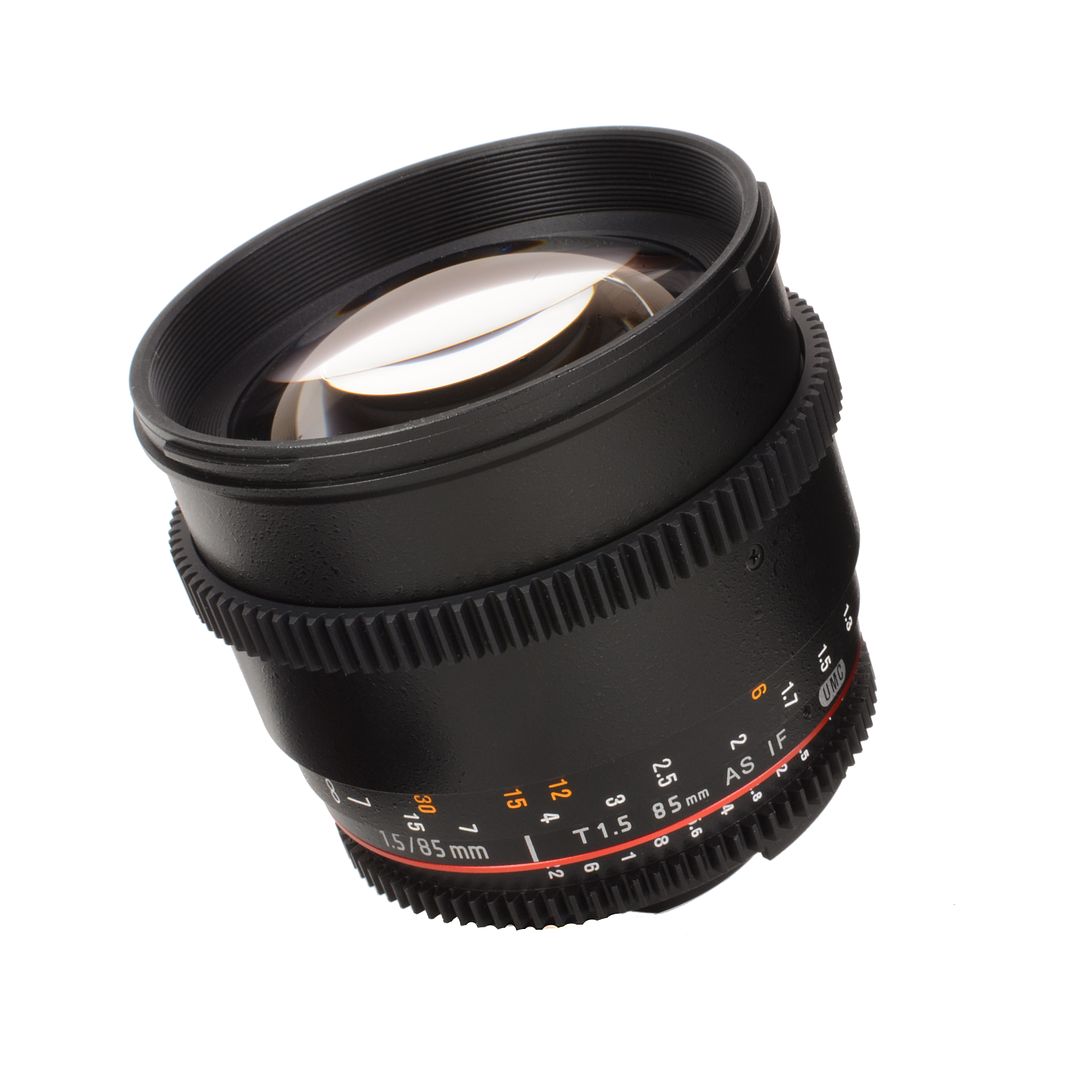





Five new E-mount Rokinon/Samyang lenses released and preorders!

UPDATE: Bhphoto listed five new E-mount lenses from Rokinon Samyang! These are all Cine lenses (smooth aperture control). Someone raised the question that this may be a BH mistake. But their text clearly says it’s for NEX.
8mm T/3.8 Fisheye Cine Lens for Sony E at BHphoto (Click here).
14mm T3.1 Cine Lens for Sony E at BHphoto (Click here).
24mm T1.5 Cine Lens for Sony E at BHphoto (Click here).
35mm T1.5 Cine Lens for Sony E at BHphoto (Click here).
85mm T1.5 Cine Lens for Sony E at BHphoto (Click here).
Don’t forget that there is also an upcoming Rokinon 8mm T/3.8 Fisheye Cine Lens for Sony A-mount (BHphoto), the 24mm t/1.5 A-mount (Amazon) and the 35mm t/1.5 for A-mount (Amazon).
As usual be aware that Samyang has mane different brand names. Click on these Slidoo eBay links to see a list.
USA: Rokinon, Samyang, Opteka, Bower and in Europe: Samyang, Rokinon, Walimex, Falcon, Vivitar.
Note: Slidoo is a SAR developed official eBay App (in Beta phase). Subscribe to change country and help me testing this project. Thanks!
—
Samyang also sent us the press release text of the 85mm t/1.5 lens:
Press release:
Kraków, 9th of November, 2012 – Samyang Europe proudly informs about releasing at the turn of November and December brand new video lens Samyang T 1.5 85mm AS IF UMC.
The lens will join Samyang’s VDSLR family and will be available with following mounts: Nikon, Canon, or Sony. Optical construction, similarly as in case of classical version, comprises of 9 lenses divided into 7 optical groups and provides internal focusing function. It should be also noted that one of the lenses is aspherical. Iris diaphragm allows one to produce aesthetic bokeh. All lenses were covered with multilayered, anti-reflective coatings, which add to the very high level of light transmission. As in the case of the rest VDSLR lenses, the aperture and focus rings are featured with gears, allowing to control work of the lens with follow focus system.
Samyang T 1.5 85mm AS IF UMC will be available on sales at the turn of November and December, but for those, who would like to have it earlier, Samyang Europe prepared a special contest. The prize is the brand new 85mm VDSLR itself. To win the lens a short video needs to be made. All necessary information is at distributor’s offical site: www.samyang.pl and its Facebook fanpage: https://www.facebook.com/samyangpl
Welcome to the fun!
Samyang Europe
via Cheesycam.


BluePixel
8 months ago |Can someone enlighten me how cine lenses are different from normal ones.
Are they manual focus ? And aperture is not fixed like 1.8, 2.4, 5.6, 8 and so on. Instead it can be anything in between ? Like 1.98, or 2.7, or 8.13 ?
What else is different ?
Sorry, never used one.
S.
FreXxX
8 months ago |Yeah, as far as I know that is the case. Also, the are usually calibrated to T-stops, not F-stops. F-stops are only calculated, while T-stops are measured. If you look at two 50mm lenses with F2, they don’t have to let through as much light as the others. So this means, you might have differend settings to shoot them, or the one picture is exposed different than the other. And T-stops are always the same. How I understood that right.
Tokuojerry
8 months ago |That’s exactly right. I contacted SLR Magic directly to put my name on their notification list for their upcoming 24mm f1.4 e-mount CINE lens. In their mail they answered my question that F-stops are an ‘about’, calibrated value whereas T-stops are measured values. Thus, two different lenses with the same f-stop may not necessarily let in the same amount of light and produce the same results versus two lens measured with the ‘T’ rating. I also understand these lenses are more critically used for video production versus ordinary lenses. Thus, the designation CINE lenses. Theoretically a higher lens. They are not the same according to SLR Magic.
J-Man
8 months ago |T-stops = f-stops minus losses(ie. reflection, absorption, etc…)
The main purpose is for keeping the light levels the same when switching lenses while filming a scene.
Michele
8 months ago |I’ve never used them eitherl, but it looks like they might work as the awsome A mount 135 STF f2.8[T4.5]. In this lens you can steplessly set the aperture between T4.5 and T6.7 (where T stands for “transmitting”), while when you choose to set the aperture via the camera you get the usual steps that we know. The lens at T4.5 transmits the same amount of light as a normal f4.5 but with a depth of field of f2.8, this due to a special extra lens (apodization lens) that makes bokeh super creamy.
Maybe these lenses works in a similar way bokeh wise (since they’re marked “T” instead of “f”); you’re right: aperture can be set as you like it, it’s a manual focus (samyang doesn’t have autofocus and IF the lenses are equipped with an apodization lens for better bokeh then the autofocus won’t work anyway).
Having the option of steplessly control the aperture, means you can control the depth of field as you like.
This is just my own thought: I might have way out!
If you’re interested to see how it works, check http://www.the135stf.net/
Take care.
Michele
8 months ago |I meant “I might be way out” and not “might have…”
Joel Richards
8 months ago |i’ve never used the 135mm STF but I doubt it. The STF is specifically designed for creamy bokeh the ‘T’ here just means the aperture is measured in T-stops instead of F-stops. So yes, t1.5 with look the same as f1.4 because its probably the same aperture opening just measured differently.
Michele
8 months ago |Well, as I said, I’ve never looked at the “tech” behind them so maybe you’re right. T1.4 is the same as f1.4 in a cine lens: they just mark the lenses as “transmitting” light as an f1.4 aperture. Mine was just a thought about how these Samyang lenses could have been built…
BluePixel
8 months ago |See, that’s what I am after, creamy bokeh. I was considering Zeiss 135/1.8, but this will be a little too long on APS c nex 6 and too big with LA FA2. So maybe a new Samyang 85 E mount better option ??
Michele
8 months ago |Well, if it’s creamy bokeh you’re after then absolutely nothing is better than the 135 STF. I have it and it’s absolutely gorgeous: tack sharp all the time, excellent contrast and colors. It suffers some “purple fringing” when you’re taking pictures of things really shiny (such as sun reflecting on pottery or water for example) but sometimes that fringing gives cool results (on water games out of fountains, for example). I can understand that maybe manual focus and a 200 equivalent on APSC is not ideal (maybe); but I’ve read about people using in on APSC and they’re really happy. It’s up to you. You should be reading some tests about Samyang and decide. Personally I would buy the 135 STF over and over again.
Alec Berry
8 months ago |I have the 135 STF, and it is labeled in “T” values. These T values mean exactly the same as the Samyang lenses– it is a measurement of the brightness of the lens. As others have noted, the apodization filter in the STF soaks up a log of light. When the STF is set at f/2.8, the intensity of the light on the sensor is similar to f/4.5. Labeling that as f/4.5 would not be correct, since the aperture is indeed at 2.8. But labeling it as 2.8, while technically accurate, is misleading because it will be darker than one expects at 2.8. So Minolta borrowed an idea from movie and video lenses, and used the T value.
Samyang is using the T value, but for a different reason. In video, you want to be able to control, or match, the relative brightness of different cuts in a scene, even if different lenses are used. By measuring in T values and having a stepless aperture, two lenses can be exactly matched. Two different lenses at the same aperture will not always let the same amount of light in, due to different coatings on the lenses, number of lenses, and other factors.
A better way to understand it is to think of older professional movie and TV cameras, the ones with a revolver type of arrangement on the front. All of the various lenses could be set to the same T value– regardless of f/stop– and thus when flipping through lenses they would all be the same brightness.
One big difference, however. The STF communicates the aperture/T value back to the camera, but the Samyang lenses don’t.
xedi
8 months ago |Usually cine lenses don’t breath (as much) as photo lenses. When you adjust the focus on a photo lens, then the focal length also changes, which on still images is not noticeable since you only have that one picture but when you record while (re)focusing, then breathing can be distracting.
Chris K.
8 months ago |I bought the 24mm T/1.5 lens (can’t remember why, although I did want a wide/fast prime, but why I bought a cine lens is beyond me.)
1) there are no clicks on the aperture ring (so you can change aperture with no noise on video recordings)
2) there are teeth, and I mean big uncomfortable to grab teeth, for focus pullers
3) the focus/aperture indication is offset 90˚ to the left (counter-clockwise)
I debated and ended up exchanging mine for a non-cine version of the 24mm lens. (Note both were A mount lenses.) The Samyang lenses are plastic but very solidly built and have a ton of glass so you get your money’s worth.
tokyojerry
8 months ago |When I contacted SLR Magic to place myself on a notification list for their upcoming 24mm f1.4 CINE lens, I also inquired about the difference between the ‘T’ versus ‘F’ factor. In short, f-stop is calibrated (an ‘about’) factor, and the ‘ T ‘ is actually a measured factor. For the same f-stop setting between 2 lenses you might not have the same amount of light reaching the sensor because each lens might have slightly different calibrations. The ‘T’-measured lenses, usually in the CINE lenses is accurate across different lenses being a measured value. Thus, the T-value is used in CINE lenses which are theoretically more critical in video productions for non-CINE lenses. I am new to this T-number concept myself, but if interested further reading on the matter is available at Wikipedia:
http://en.wikipedia.org/wiki/F-number
F-stops are purely geometrical, the ratio of aperture to focal length, regardless of actual light transmitted. Since all lenses absorb some portion of the light passing through them (particularly zoom lenses containing many elements), f-numbers do not accurately correlate with light transmitted. F-numbers corrected to measure light transmission rather than aperture ratio, called T-stops (for Transmission-stops), are sometimes used instead of f-stops for determining exposure.[6] A real lens set to a particular T-stop will, by definition, transmit the same amount of light as an ideal lens with 100% transmission at the corresponding f-stop.
Adam
8 months ago |Hmm, I’m guessing these are manual lenses? And since the NEX does excellent with manual focus lens, I wonder how would this suffice as a photographic lens as well.
Great to see there are some more cinema lens options besides the Zeiss CP.2 for E Mount.
Kenko
8 months ago |Are you really sure that these are for e-mount and not for a-mount? I think BHphoto have just made a mistake. There is nothing that indicates e-mount in the press-release. Also why they would release same lenses for Canon and Nikon at the same time. Those lenses would have to use different optical formula,because they are designed for cameras with long flange distance.
Kenko
8 months ago |These lenses are made for A-mount not E-mount. BHphoto have made a mistake.
ssdfsd
8 months ago |Can anyone describe the difference between follow focus and auto focus?… Furthermore, can the aperture still be automated?
Bobbeijing
8 months ago |I think it’s much more likely they’re made for E mount rather than A mount, since E mount incorporates video cameras such as the FS100 and FS700.
Joel Richards
8 months ago |Does anyone know if these are actual redesigns (like the 2nd 8mm fisheye) or just the same VDSLR version with an “adapter” permanently mounted?
EDIT: if they are more compact and still full-frame I’d seriously consider buying some even if I mostly shoot stills.
John Maverick
8 months ago |If they’re fullframe, then might be quite a nice E-Mount option for the VG900. Video/CINE needs image stabilisation the VG900 succeeds with its IBIS.
Hendrick
8 months ago |By the look of the size of the lenses, and the focal length as well as the T stop, I think they are for APS-C. A 24mm with a Tstop of 1.5 would be as large as the 24mm 1.4 SLR lens, at least, even if it is for mirrorless systems.
I would also imagine the planning of these lenses dates back before the VG900, so more likely they saw that APS-C is the market for it.
John Maverick
8 months ago |The 24, 35 and 85mm specs state ‘fullframe coverage’ according to the BH links. The 8 and 14mm don’t say their image circle.
Luffy
8 months ago |Unless the description at BHPhoto is wrong, fullframe is supported.
Hendrick
8 months ago |Then the 24mm lens will be quite big for a NEX cam with no exclusive video purposes. Shame, I was looking forwards and alternative to the Zeiss 24mm 1.8, I am not looking into the 21mm voigtlander ultron.
Pablo
8 months ago |Samyang site has the data sheets, they all list them as having E-mount versions, they must need or have an adapter attached.
AdamH
8 months ago |Apparently you can pre-order both the A-mount and E-mount versions.
So the A version works with A and E cameras but E is limited to only NEX.
I see no point in buying the E version att all when it is as big as the A.
AdamH
8 months ago |Search B&H and you will see there’s five Cine E and five Cine A-lenses coming.
andy
8 months ago |Very good news I going get all the prime set of samyang . For my fs100 it is gonna be perfect . I do not understand why people care so much about multi adaptable mount . If I change camcorder I will sell lens . You never lose too much ,when you want sell used lens. I am waiting for 50mm samyang please .
Andrew Ptak
8 months ago |Didn’t they announce a tilt/shift at Photokina? Has anythig happened with that?