



The impossible is possible. Sony should learn from Pentax how to make pancake for NEX!

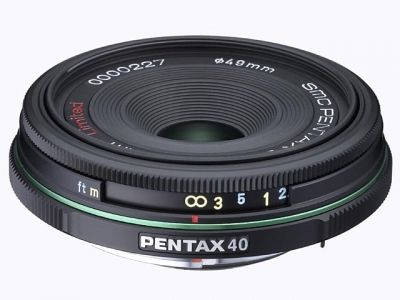
Sony, it’s possible! The picture on top shows you the Pentax DA limited 40mm full frame lens (!) for the Pentax DSLR system(!) with top notch quality and relatively fast aperture (f/2.8). Why I am writing this? I am a proud owner of the Sony NEX-5n but I need very tiny lenses for the camera. And I want to debunk the myth saying that unlike MicroFourThirds Sony cannot make ultra-small lenses on the larger APS-C sensor. The pancake from Pentax covers a fullframe sensor and it’s small although it is designed for a DSLR system! In theory such a lens could be even smaller if designed for a mirrorless system! I would be very happy if Sony would make some sort of special edition of pancakes with manual focusing only. So why am I NOT going to buy the Pentax lens for my NEX? Easy, because the K to NEX mount adapter alone is twice as large as the lens itself and as a result the pancake size advantage disappears. I didn’t find any picture of that lens mounted on the NEX. I only found one single image samples of the NEX-5 with the Pentax lens on Flickr (Click here).
Sony do it! And if you can’t…buy Pentax
Links:
Review at Photozone.
Pentax DA 40mm limited lens on eBay.
K to E-mount adapter on eBay.

Adam Welz
8 months ago |and the even better thing about the Pentax 40mm is that it has a focusing distance scale…
G700
8 months ago |Panasonic also made pancake ZOOM for their m43, Sony is just being lazy retards for not releasing a decent fast/sharp pancake (like panasonic 20mm/F1.7 for example)
Engineer
8 months ago |I love it when people who don’t understand the basics of optics call a company with decades of quality lens design “retards”.
Its really easy to make a pancake that covers a full frame sensor when you have the additional distance of a mirror box.
Getting rid of the mirror makes for smaller cameras, but not necessarily smaller lenses.
Chris
8 months ago |sure..
so samsung did use magical to produce the 16, 20, 30mm pancakes for the samsung nx ? *rolleyes
Jojo
8 months ago |Yes , of course it is possible to produce small compact lenses for the Sony NEX, but I don’t think the Pentax 40/2.8 should be the prototype. Unfortunately years of SLR lens design have given the impression that lenses have to be large and complex = actually not the case – but looking at 35mm cameras such as Minox EL, Olympus XA will show us very small 35/2.8 lenses, and Olympus, Canon & Minolta used to make rangefinder cameras with lenses as fast as 40/1.7 – all these examples are FF. Ricoh even took their 28/2.8 design from a compact camera and produced a Leica M mount pancake lens version.
The Pentax DA40 is a variation on the mid 70s M series lens, again FF, a shortish standard lens. Although it looks small by itself, it is around 60mm from image plane to lens front, so a NEX version would be 42mm long. However, if we bear in mind FOV, a true equivalent of this FF design on a NEX would be 27/2.8. The actual physical size of the Pentax 40 is probably around as short as you can make a lens (quoted as 15mm, but in reality about 20mm long with the last 5mm within the bayonet mount). So we have a simple Tessar type lens 20mm long with a space behind it equal to its FL. Remember that SLR lenses are designed with increased rear clearance for the mirror, so this could be a smaller design if needed, but let’s take the Pentax design as a starting point. Reducing the same design to 27mm FL, we would get a lens cell around 20mm long with a clearance behind of 27mm – a total of 42mm from image plane to lens front. With 18mm of NEX body, the removable lens would be around 24mm long. So a shortish standard lens (27/2.8) is definitely possible at less than 25mm long.
Now the Pentax 40mm design and similar short standard pancakes from Nikon, Contax, etc. tend to be simple 4/5 element f2.8 designs, and faster designs with better optical formulas are going to be bigger, but there are many options in lens design, glass types, etc. available to produce pretty much whatever you want – for a price. The designs that make it to production need to be cost effective and appeal to potential buyers. Panasonic have proved there is a viable market for compact primes for CSCs, I think Sony should have at least one! Perhaps the demand is more for quality faster primes a little bigger than pancakes, but I think every CSC system should have a pancake option, they are very pocketable for when occasion demands.
Xavier
8 months ago |Actually, it’s an autofocus lens, but the motor lies on the camera
Sahaja
8 months ago |Stabilization on Pentax is in the camera too.
Nikola
8 months ago |Where is the picture of the lens?
Jiri
8 months ago |+1
Arnold
8 months ago |The flange focal distance of the K mount is 45.46 mm, NEX’s is 18mm,
if you add the lens length of 15mm with that difference, the result is 52,45mm.
Maybe a native E mount lens can be made a bit shorter but I guess by not much,
its optical formula is possible because there is the space taken by the mirror box.
hanugro
8 months ago |Hm, I knew it that short flange focal distance has some trade of. Sure it enable lots of other mount lens to be mounted with adapter but I believe it also make difficult to design native lens.
ItsaChris
8 months ago |It does not make it hard to design native lens. It just means the flange distance needs to be added to the lens to adapt exciting lens designs.
I cant believe the admin posted this. Hes needs to edit his post ASAP!
“in theory such a lens could be even smaller if designed for a mirrorless system!”
That is wrong! the lens would be the length of the lens + K adapter. In theory the lens could be smaller than that if it was made collapsible.
Please look at how large a collapsible lens could be –
http://www.talknex.com/f2/sony-nex-lens-lineup-one-mans-dreams-293/
Not only are you stirring the pot with this type of post you are giving people completely wrong information… some of your latest post have done this (like the Dox comparison with the A77 and 5d mk II/ D700.)
T.J.
8 months ago |finally someone who knows what is up, elements to sensor is important and you must have correct angle for optimal light. OH well I would love to see something as pancaked as this lens but physics is hard to get around
Vlad
8 months ago |Leica apparently bent the laws of physics.
Engineer
8 months ago |No, they didn’t. They put lenses on their sensor to correct for the problem… which exists in all digital cameras, but not in film cameras. This is one reason Leica went for so many years without doing digital, they needed a million tiny lenses in front of their sensors to rectify the angle of incidence problem.
Why is it the people who are so ignorant always are so smug when displaying their ignorance, as you just were?
Vlad
8 months ago |There’s nothing smug about my comment (merely light irony), but apparently you decided to read it the way you were feeling at that moment.
Also, I don’t see what’s so ignorant about it, so I hope you can clarify. My point was exactly what you said – sensor lenses = there are many ways to achieve something.
Sahaja
8 months ago |What Engineer said is correct.
And with the Leica M9 it is easier than with MEX since the flange focal distance for M-Mount (27.80 mm) is greater than that of NEX E-Mount (18 mm).
Leica rangefinder cameras are also designed to be used with lenses of a very limited range of focal lengths – which should make designing the corrective micro lenses much easier.
If you compare then you’ll also see that many of Leica’s recent lenses (i.e. the ones designed for digital) are larger than their older designs.
Vlad
8 months ago |I never said he wasn’t. What I don’t agree with is how he’s reading my comment.
ItsaChris
8 months ago |yes but the macro lens do not allow there lens to be shorter than physics demand. They just make the sensor able to accept off angel light rays with less optical flaws.
Vlad
8 months ago |It is 42.46mm. I am sure they can make a lens with around 30mm thickness easily, which would be quite nice already.
Mistral75
8 months ago |K mount flange distance is 45.46mm
Vlad
8 months ago |Yes, it is.
Engineer
8 months ago |It’s not how I read your comment, its that your comment was a lie. There’s no other way to read a lie.
Having been caught in a lie (that all leica needed to do was design a lens) it exposes the lie behind everyone’s claims that Sony has some perverse desire to stymie people by making lenses bigger than they need to be.
b_z
8 months ago |Buy Pentax, Fuji and Leica.
hanugro
8 months ago |Yes, for NEX, pancakes is more essential, especialy for primes. No need to goo this thin as NEX needs to include motor but 50% longer will do.
Sahaja
8 months ago |@hanguru
Which is more important to you IQ, size, or speed?
There are always trade offs
If you want a fast lens it will be bigger than a slow lens.
If you want a lens with best IQ it will usually be bigger too.
Pancake lenses generally sacrifice speed and IQ for size.
40-60mm for full frame and about 35-40mm for APS-C seem to be the optimal focal lengths for making”pancake” lenses.
räven
8 months ago |Why is the lens fullframe when there are no fullframe pentax dslr’s?
Mike
8 months ago |It’s for film Pentax cameras
LuckyNumberSlevin
8 months ago |So it is not for DSLR but for SLR.
FYI
8 months ago |The lens itself work fine on Pentax AF film SLRs, but Pentax doesn’t make FF DSLR, yet. And in their current marketing scheme DSLR = APS-C. So it’s labeled and marketed as such.
Steve Jones
8 months ago |It is NOT a full frame lens according to photozone, but a dedicated APS-C lens.
http://www.photozone.de/pentax/124-pentax-smc-da-40mm-f28-limited-review–test-report
Mike
8 months ago |Oops…I was misled by the admin. It’s not full frame and it’s for DSLR…
Mistral75
8 months ago |It is for DSLRs and it is the digital version of the 1976 “smc Pentax-M 40 mm f/2.8″ full frame lens.
Vlad
8 months ago |It does cover FF.
Sahaja
8 months ago |This is a DA lens so, officially, it is only for APS-C DSLR’s. It may cover more, but there would likely be problems with the quality at the corners of the image.
Another thing is the maximum aperture of this pancake lens is only F2.8 – pretty slow for a normal prime.
Now suppose Sony were to adapt this lens design for the NEX. Add the difference between the flange focal length of E-mount and that of K-mount, and the lens would be 3.5x as long as it is. Add an auto-focus motor and it may need to be fatter. So you’d end up with a 40mm f2.8 lens that is 52mm long.
If Sony produced a 40mm f2.8 prime lens that was 52mm long and 62mm in diameter (same as other NEX lenses) it wouldn’t satisfy those who want “pancake” lenses – and the rest would complain that the maximum aperture was too slow.
I’d rather have Sony’s 50mm f1.8 lens which is only 10mm longer than that (physically and in focal length) and a stop and a half faster – and costs less than the Pentax pancake.
Sony’s decision to have a very short flange focal length distance on the NEX means that native E-mount lenses are almost always going to be larger than they would be had they chosen a longer flange focal length distance (like Samsung). What size you save on the body thickness you lose on the length of the lens. However the advantage for NEX is that you can easily adapt almost any rangefinder or SLR lens. Samsung NX does not have an adapter for M-mount lenses.
I suspect Sony will eventually make some collapsible lens designs for the NEX that will at least be more compact for carrying. But even then there may be some tradeoffs in terms of rigidity, reliability and maximum aperture.
Vlad
8 months ago |Agreed with pretty much everything, but how do you come up with 52mm length? Am I making a mistake, because I am at 42mm?
Harvey
8 months ago |It’s possible. Nobody said it wasn’t. It only takes time to develop pancake lenses. Pentax made the development a long, long time ago, they already had the 40 mm pancake 40 years ago, if I’m not mistaken. You might desperately need pancake lenses, and others like me might want them too, but the majority of us photo-enthousiasts want AF-zoomlenses, I’m afraid. I always shoot with primes, against all fashion, but even in circumstances where the use of fast primes would really make sense (e.g. concertphotography) I only see people waving bulky zooms. Sony might bring a change, making the use of legacy lenses easier, but they simply will make more money by selling lots of zoomlenses than by selling a few fast (pancake-) primes to you (and me) only…
Adam Maas
8 months ago |While it’s officially a APS-C lens, the lens was developed for full-frame and covers full frame just fine. It was originally developed for Pentax’s stillborn full-frame DSLR based on the Phillips 6MP sensor also used on the Contax N Digital. Pentax killed the camera when it became clear that Phillips couldn’t deliver the promised performance or price for the sensor.
The DA 40 is also an update of the older SMC Pentax-M 40mm f2.8 pancake, which is only very slightly larger as it had to incorporate an aperture ring. That lens dates to the late 1970′s. the DA Limited updates it with an aspherical element and improved optical performance.
ee
8 months ago |tank god someone understands versus crying out an article,
Raul S.
8 months ago |What Sony needs is at least one more compact lens, maybe 5-10mm longer and with a focal lenght around 24-35mm range and with good quality (no OSS required). Or even, if they want, design a 24mm f/3,5 wit the same size of the current E-mount pancake and good optical quality.
Now admin, to talk about your post…just don’t get easy on it. Hope you’re very aware of the loooong registration distance that makes everything easier for designing a certain lens…First, try to understand the physical limitations of your camera, and what it takes to design compact lenses with only 18mm registration distance and APS-C sensor size without increasing too much the pricing of their products. (Unless people wants to pay almost Leica prices)
Thom Hogan
8 months ago |I think most of us could live with high quality primes that are in the 60-80mm long range. Smaller than that would be nice, sure, but the camera doesn’t feel awkward with lenses about the size I suggest. Basically, we need three such lenses: 16mm, 35mm, 60mm.
Raul S.
8 months ago |you mean, with those equivalent focal lenght or with the actual focal lenght in APS-C? Indeed, I do prefer normal sized lenses. You got where to place your hand and provide better stabilization and doesn’t feel like a P&S camera. But I do like the smallest possible combo without looking like a SLR. So current E-mount lenses are just fine in size. All I want is good performers. Sony to secure the market, needs at least one or two more compact lenses (note: compact, not pancake) after that, they need to focus on PDAF-on-sensor technology in APS-C sized sensors, and good quality lenses.
Thom Hogan
8 months ago |I meant actual focal length (basically gives you 24, 50, 85mm equivalents, plus or minus a few mm). One could also argue for a 24mm (35mm equivalent) to fill the between wide and normal.
I agree with you: true pancake size isn’t as important as manageable size and optical excellence.
Sahaja
8 months ago |Thom, Sony have already announced 50mm f1.8 E mount OSS lens (70mm equiv) which is 62mm long. (I would have preferred a 60mm focal length – 90mm equiv)
A good 16mm (24mm equiv) that isn’t a pancake, and a good 35mm (50mm equiv) also within your “manageable size” shouldn’t be too difficult.
Mike
8 months ago |It shows that NEX was originally designed for the consumer market – to make the body as small as possible with only 18mm flange focal distance. The result is that it’s hard to design a small lens that is sharp across the frame. Consumers may not care about sharp lenses, but we do.
I’m still waiting for the delivery of my new 5N and intend to use my Contax G lenses. Let’s see how sharp the corner would be…
Steve Jones
8 months ago |Yet another post that ignores the point that DSLRs have a much longer lens register. The K mount has a lens register 27mm bigger than that of the E-Mount. Use the same lens design, you have to add that to the barrel length. That would make the total length of such a lens 42mm and it is consequently impossible to make the E-Mount lens smaller.
The E-Mount lens also has to have a focussing motor. It would also not be possible to put OS into a lens of this design.
Of course, if the Pentax lens is truly FF (do we know for sure – all I can find out is this is optimised for digital cameras) then you might shave a bit off the diameter.
If you want to see what the total length of such a design lens for the E-Mount would look like, just connect it to the appropriate mount adapter.
For those who know anything about lens design, then they will no that for a guassian-style lens (where the rear focal length equals the front), the lens length cannot possibly be less than the focal length less the register. In practice, it’s a bit more as lens groups have a finite size and there are filter mounts etc.
The only way to make a lens + register shorter than the focal length is to produce a telephoto design (which has a read focal length shorter than the front). Such a design on a standard prime lens would be perverse. It might not even be shorter. It would certainly be much heavier and more complex. It would also increase the angle of incidence issues at the sensor edge with the danger of excessive vignetting and other effects.
So the statement that a 40mm lens could be made more compact than the Pentax is nonsense. About the best that can be said is it might be a bit smaller in diameter, but it will most certainly be much longer. The total back-to-front dimension of the camera and lens combination is going to be approximately the same for the same type of lens design.
I suppose a collapsible lens design might be possible, but that’s about it.
Steve Jones
8 months ago |OK – I’ve just found the information on the coverage of this lens, and it is NOT full frame according to the review at Photozone. This means that the lens elements cannot be reduced in diameter.
http://www.photozone.de/pentax/124-pentax-smc-da-40mm-f28-limited-review–test-report
So an E-Mount lens of this design will be about 63mm in diameter and 42mm long before any allowance for focus motors. Anybody expecting a 15mm thick 40mm f2.8 focal length lens for the E-Mount is going to have to keep wishing as it’s (almost certainly) optically impossible.
Adam Maas
8 months ago |It is full-frame, the only DA non-telephoto that is. The lens was originally developed for Pentax’s stillborn FF DSLR which predated the APS-C line and is an update of the much older SMCP-M 40/2.8. The DA 40 Limited has been used successfully on the PZ and *ist series film cameras with full coverage by people on the PDML.
Steve Jones
8 months ago |I’m sure it will work full-frame film – mostly APS-C cropped lenses will with varying amounts of vignetting. There is no FF Pentax, and digital sensors are less tolerant at the edges than film.
However, I’m if I can’t trust photozone, then I’m still looking for the formal specification as the Pentax site is not very forthcoming.
nb. the full versus cropped coverage issues seem not to make a huge difference in the sizes of prime lenses apart from on Canon where they intrude into the mirror box of FF designs, so it’s probably a minor part of size differences. Zoom lenses seem to gain a lot more from smaller coverage – possibly because of all the extra elements that losing a little diameter from each element, and therefore thickness makes for a lot more room.
frosti7
8 months ago |There are buttloads of FF pentax, but they are film, nevertheless people still shoot film and using new lens as well
Adam Maas
8 months ago |There in fact was a FF Pentax, Pentax’s first DSLR project was a 6MP FF body based on the Phillips sensor also used by the Contax N Digital. The DA 40/2.8 was developed for this body and is NOT an APS-C design unlike the later DA lenses. Unfortunately the camera in question was cancelled late in development due to problems with the sensor (they’d already been showing Prototypes off at press events) and Pentax developed the *istD APS-C body instead.
Anu Nyymi
8 months ago |And of course you don’t understand lens design yourself. The shorter the flange focal distance (or rather the exit pupil to sensor distance), the easier it is to deasign a lens (wides and normals), and the smaller they can be made. The trade of is increased vignetting and possibly lateral chromatic aberration.
If you want to know what is possible, look for full frame Leica M-mount lenses – the Voigtländer 35/1.4 for example is tiny. That is f/1.4 and full frame!
Steve Jones
8 months ago |I most certainly do understand optics – it was one of those things that tends to get covered in Physics degrees, albeit practical lens design is another thing.
The point about using shorter lens registers is, yes, you can design shorter length and simpler lens designs. However, the range over which that can be produced is relatively limited. Very thin lenses could be designed for the E-Mount between about 16mm & 24mm (ignoring space required for focussing motors).
However, once you get longer the lens elements are pushed out further unless you adopt telephoto designs as, indeed, the Sony 50mm f1.8 does. However, doing so adds extra length and complexity (also I suspect they do it to add the extra floating elements for OS).
I’ll repeat it again – you simply can’t take that Pentax design and make it into a thin pancake for the NEX – it simply will not work. Or rather, it could never actually focus on anything.
As far as Leica goes, they don’t have a current 40mm lens, but the 25mm f2.5 is 34mm long. Add in the difference between the M-mount and E-Mount register, such a design would be 44mm long. That’s three times the thickness of the Pentax design and 5mm shorter in focal length and it doesn’t have a focus motor as the E-Mount requires.
So yes, you can produce pancakes for E-Mount (and how about a definition – no bigger than the 22.5mm of the 16mm lens). However, that’s almost certainly only possible for focal lengths between about 16mm and maybe 24mm).
So a challenge. What current Leica lenses out there that are less than 22.5mm, let alone the 15mm of the Pentax?
Steve Jones
8 months ago |nb. just looked up the Voigtländer 35/1.4. Such a lens design for E-Mount would be 38.5mm long without any focussing motor. It could almost certainly a design not adaptable for OS.
So, again, you can have (reasonably) compact lenses if you forgo OS, but they will always, outside a small range of focal lengths, be longer than the M-Mount equivalent and thus look proportionately bigger on an NEX.
Mistral75
8 months ago |> So yes, you can produce pancakes for E-Mount (…). However, that’s almost certainly only possible for focal lengths between about 16mm and maybe 24mm.
I suggest you to have a look at the three pancakes for Samsung NX: 16mm f/2.4, 20mm f/2.8 and 30mm f/2. The NX mount register is 25.5mm.
Steve Jones
8 months ago |The Samsung has a NX mount has a 25.5 mm lens register; 7.5mm longer than the NEX. That makes a 20 & 30mm very doable as pancake lenses using few elements (especially if some intrusion of elements into the body is allowed). A 20mm of that design would be 32mm long on NEX and 20mm would be 29mm – both notably thicker than the 16mm NEX at 22.5mm. So it’s a matter of what you define as a pancake.
Comparing the NX 30mm with the 30mm NEX macro, the former focusses down to 25cm and the latter manages 9.5cm. That requires a lot of extension, and it’s this macro nature that will dictate the lens length.
The 16mm NX is a bit more interesting. Unfortunately I can’t find any specifications, just a picture. However, to put a 16mm lens on a body with a 25.5mm register body implies it must be somewhat retrofocal in nature. In some ways that’s good – it will reduce the angle of incidence effects on the sensor edges. However, again to compare this with NEX 16mm you have to add that extra 7.5mm to the lens length. The NEX 16mm will certainly be thinner as it fits well with the native lens register, even before this extra 7.5mm barrel length.
So I’ve never denied that shorter, more compact lenses can be produced for the NEX, just that, outside a fairly narrow range, they will not be “pancakes”, in that by the time you reach 24mm or so the length will be probably in the 25mm+ region. Also, any such pancake lenses will have modest close focussing capabilities for their focal length and will not carry OS. Certainly I find it difficult to believe anybody could design a 40mm pancake for the NEX that was just 15mm thick (as it would have to be telephoto) which is what the headline of this story implied was possible.
ItsaChris
8 months ago |steve^
If the 16mm samsung is any good (and it is retrofocal design) I think it would be interesting to see a small nex lens around 12 or 14mm with a retrofocal design.
Sahaja
8 months ago |@Steve
> “So yes, you can produce pancakes for E-Mount (and how about a definition – no bigger than the 22.5mm of the 16mm lens). However, that’s almost certainly only possible for focal lengths between about 16mm and maybe 24mm).”
But unless you use a retrofocal (physically longer) design with wide angle lenses you have problems with the angle the light strikes the sensor at the edges.
Sony of course have a 16mm E-mount “pancake” – released with the first NEX – but it got bad reviews and that must have discouraged them from making more “pancakes”.
Steve
8 months ago |+1
The laws of physics are what they are and this camera is what it is and Sony can’t do anything to change it.
It’s a nice little camera that produces great images, but it’s never going to be the tiny powerhouse envisioned by some.
Someother camera will be designed and marketed hopefully one day that meets the dreams of many NEX buyers for a high quality camer with SMALL optics.
So everyone out there that wants Sony to sell a true pancake lens of camera body the thickness of a finger forget it, it’s not going to happen and no firmware fix will ever make it happen.
Rodrigo
8 months ago |I agree. The NEX-3 and 5 are (at least in the original intention) more for the upgrader from bridge cameras rather than pros or dedicated hobbyists. One gets spoiled by 10x or 20x zooms and most people would rather by a versatile 18-200 f3.5-5 than a 50f1.8 for the same price regardless of IQ tradeoffs, simply because 99.5% of their pics are family/vacation which will never go beyond a PC’s hardrive or Facebook.
The 16f2.8 is not a bad lens at all and paired with the 18-55 or the 18-200 is what most consumers need. Once you have established the poduct, then you go for more specialized lenses.
Pancakes without AF are smaller but I don’t think Sony or Zeiss will make e-mount MF pancakes their priority when developing e-mount glass.
explorer76
8 months ago |@Rodrigo – I am not quite sure about this. The number of consumers who lug around a 20x zoom P&S with them is actually not that great. Large majority of the consumers carry a small P&S which can be with them most of the time. Thats also why a lot of consumers still resist going to DSLRs as they dont want to lug around that big setup. So I doubt that something like NEX + 18-200mm ocmbo would be a very compelling package for most consumers. Also keep in mind that perhaps the largest number of consumer pictures are taken using cell-phone camera with fixed focal-length lenses and people easily live with that limitation for the convenience of having a camera with them all the time. Sometimes people people on these forums consider the consumers to be total dummies who don’t know anything. Well sure a typical consumer might not udnerstand the technical details of how various factors impact image quality etc but they do have the ability to understand the tradeoffs between size, flexibility and quality etc
Rodrigo
8 months ago |Maybe it is my experience from upper/upper-middle class in Peru. Compacts are giving way to either cellphone/tablet cameras or bridge. You even see DSLRs in the hand of the not-quite-photographically inclined, but mora as a status symbol than anything.
explorer76
8 months ago |Sure – but forget the Pentax, Samsung has a 30mm f2 pancake which is small, light and optically very good. As far as I understand the issue is that in a bid to make the camera as compact as possible Sony made the register distance too small. The result being that it is now difficult to make small lenses for the system. They got the initial “WoW – look sony can make it so compact even with an APS-C sensor” remakrs. However from aan overall system compactness perspective (i.e. camera + lens), it seems that NEX might lag behind an APS-C mirrorless system designed with a more reasonable registeration distance. It seems this was a case of marketing concerns overruling the long term technical concerns.
Sahaja
8 months ago |There are drawbacks, but the good thing about having such a short flange focal distance is that you can adapt almost any rangefinder, SLR, or DSLR lens to the NEX – even those lenses designed for M4/3 that cover the larger APS-C sensor.
That is a major reason why many enthusiasts like the camera.
Patrick
8 months ago |Hallo Andrea,
das Auflagemaß von DSLRs ist ca. 40mm – deshalb kann dieses Pancake auch so klein sein. Sobald die Brennweite kleiner wird muss mittels Retrofocus gearbeitet werden und die Objektive werden größer. Bei einer Nex würde ein 40mm natürlich größer sein – man muss ja mindestens auf die Brennweite kommen – das heißt, man muss den Spiegelschacht an Baulänge wenigstens dazurechnen.
Den Beitrag finde ich nun wirklich quatsch!
CRB
8 months ago |Sony should learn from anyone how to make the E-lenses, since they are worst tham m4/3s, samsungs and ricoh too….
Mike
8 months ago |I forgot to mention that it was reported NEX7 has micro lenses built in to improve the corner sharpness when using legacy lenses. If it is the case, then perhaps Sony would use this feature in all future NEX bodies and introduce some smaller lenses. I really hope it would be the case.
michel v
8 months ago |Oh, cry me a river.
It seems like commenters here will never be happy until Sony releases a 10-1000mm f0.7 ultra thin pancake zoom that weighs 100 grams!
This is getting ridiculous.
fs
8 months ago |Maybe… but it had better be sharp at the corners wide open!
DigiFilm
8 months ago |And it had better have OSS since the camera only goes to a pathetic ISO 25600!
Harvey
8 months ago |My self-assembled Minox-Minotar 2.8/35 mm for Nex makes my Nex-5 body 26 mm deeper, works terrific and optical quality is more than decent. Find proof on Flickr: Taiwan’s Riccardo has a lot of samples.
That goes to show a pancake standard-lens shouldn’t be bulky. Hard to build? Yes! The Minotar didn’t get copied, finds its only equal in the Rollei of those days. Olympus, even though an optical giant, didn’t manage to obtain the same quality in the XA.
I would like to contribute another question to the discussion: I have been assuming that the bulky 24 mm Zeiss is in fact built to cover a FF-circle and therefore big. The 16 mm won’t cover a FF-circle, I think. Anybody here who knows this?
Maximus
8 months ago |no way of the Zeiss 24mm 1,8 covering full format, look which diameter the Zeiss 24mm f2 for A-Mount has (72mm), the E-mount lens has just 49mm and has a slightly faster aperture
joel
8 months ago |The 24mm Zeiss for A-mount uses a different optical formula and as it has been pointed out (assuming the physics is right) the 24mm Zeiss fits at the “sweet spot” for NEX lens size so while it may seem big for an NEX lens it could actually be much smaller than a FF 24mm on an SLR.
I do think Sony is either developing, or keeping open the possibility, of a FF or APS-H sized NEX sensor. Which makes lens design that much more complicated and therefore only certain lenses like the Zeiss 24mm, the 30+50mm primes, and the new G zoom will be built to cover full frame.
Sahaja
8 months ago |A full frame NEX – if one is ever made – would not necessarily have to have the same E-mount
Dino
8 months ago |Hell with this pancakes, cheesecakes and apple pies. I want a 35mm Planar, at least F1.4, no matter how big it is.
Steve
8 months ago |Yes, Sony get Zeiss to release its manual lenses for the A-mount like they have of Nikon and Canon.
Mike
8 months ago |Agreed…But Sony don’t make it bigger than an apple pie please
Steve
8 months ago |We keep asking manufactures to make lenses smaller, but for some reason they keep getting bigger.
Now days I shoot often with a Zeiss 24-70/f2.8, but 25 years ago I used a Minolta 35-70/f4 (mini beercan) that’s unbelievably small and lite in comparison.
Fact is, if not for being slow, this 1986 lens would match up nicely on a NEX7
Sahaja
8 months ago |+1 to the 35mm Planar
Takomaki
8 months ago |I am not a lens designer but I felt the recent patent on the liquid lens might bring Sony a step closer to creating compact lens… Just need to keep some faith, lens are not just developed over a weekend… And I am sure we are not the only people calling for pancakes for Sony.
MarkJ
8 months ago |The Fuji X100 is a fixed lens collapsable design, but when extended it’s still compact, yet f2. I believe it’s modelled on the previous 35 summicron. I don’t see why a similar lens design, but on an E-mount couldn’t be done. The Fuji has microlenses, and now do the new NEXes. The NEX 18mm distance is just a minimum, and Sony is free to choose anything above that. I think Sony is just adpating existing designs to bring them to market quickly. How long does it take to design a lens from scratch and make it production ready? Is Sony lacking lens expertise?
Mike
8 months ago |Does NEX-5N has micro lenses as well?
Mr M
8 months ago |I didnt know the X100 lens is collapsible or extendable. At least my copy doesnt ?
Surely, the X100 is much thicker and bulkier than NEX, which goes back to the same argument of flange distance.
I really dont understand why is it some of us still cant accept the fact that the size lost in the camera has to go onto the lens ……. its a zero sum game.
Oh yes, the electronic zoom lenses on M4/3. I am not a fan of electronic zooms and neither a fan of stock lenses. Sony, keep coming up with fast primes on Nex please. For zooms, I am happy to mount the 16-50m or 24-70mm on NEX . Cheers
MarkJ
8 months ago |The X100 doesn’t collapse by much, but if you fit a filter without the adpater the filter will break when you switch the camera on. Well, that’s what I read.
Yes, the point I was trying to make is that the total body + lens distance of the X100 is pretty short. I agree, it doesn’t matter whether the distance is in the body or in the lens. Why can’t Sony make 35/2 lens where the overall body + lens is the same as the X100? Maybe its microlens limitations as reverse stream swimmer says.
Maybe I should give up and buy X100!
reverse stream swimmer
8 months ago |Re: The Fuji has microlenses, and now do the new NEXes.
While the Fuji X100 have the microlenses optimized for only one lens focal length, the NEX needs to do a compromise. Some lenses requires more vignetting compensation through offset microlenses, while others don’t!
Most likely, the NEX is optimized for an incoming telecentricity of the light cone between 24-50mm focal lengths. Therefore, NEX will never become a superior ultra wideangle camera, neither a bird photographers choice for super telephoto.
reinz
8 months ago |hope sony rebuild again super lens from minolta, like Konica M-Hexanon 50mm f1.2 and 60mm f1.2
that would be great
Brian
8 months ago |Yeah, they really dropped the ball with the 16mm .. Come out with some good pancakes and I may buy a NEX.
Alfonso Cuitiño
8 months ago |I wish I could take all the plastics and rings in the front of my lenses, that would make it even more compact
E
8 months ago |Not that I have a NEX, and probably won’t for some time, but I can understand the cry for compact lenses.
So the talk about a 24 mm seems to fit the bill.
Until we could see it and Zeiss/Sony openly stated that it basically was an adapted DSLR lens, not taking advantage of the short flange distance at all.
Nice lens, but a lazy job.
Steve Jones
8 months ago |The Zeiss 24mm is a Sonnar design, and hence, in origin it is from a rangefinder background. Indeed it’s not possible to mount wide-angle Sonnar designs onto DSLRs as they aren’t compatible with the long registers of SLRs.
http://en.wikipedia.org/wiki/Zeiss_Sonnar
There are no 24mm Sonnar lenses, other than the Sony one that I can find, so it’s difficult to see how this could be an adapted design from an existing lens. I doubt that the use of the Sonnar designation is just a labelling exercise, and in reality it is a completely different design.
For it to be an SLR design, it would also have to be retrofocal in nature, the simple test of which is to compare the apparent size of the entrance pupil (at the lens front) with the exit pupil (from the rear). The the exit pupil appears larger, it’s retrofocal in nature, if it’s the other way round, it’s telephoto (otherwise the same, it’s symmetrical). If somebody has access to one of these lenses it would be easy enough to tell.
GH
8 months ago |Here’s a good discussion about the Zeiss 24. http://forums.dpreview.com/forums/readflat.asp?forum=1000&message=39223743&changemode=1
Steve Jones
8 months ago |That makes for interesting reading. If I understand the gist of it, it’s not a true Sonnar and much of it’s extra length can be explained through attempts to keep vignetting on digital sensors to a minimum. It also appears to be retrofocal in nature, probably, in part, for that reason.
joel
8 months ago |Actually most people in that thread consider it a “true” Sonnar but parts of the optical formula are reversed and it uses a slightly different technique probably to change the angle of incidence of the light hitting the sensor.
I wonder if the delay of the NEX-7 & 24mm Zeiss are due to working out the microlens formula of the camera.
Thomas
8 months ago |Please Andrea, if you make such bold statements, please learn about focal distance and what differs a NEX and other DSLR cameras.
Allan
8 months ago |and please Thomas if you have nothing more interesting than those poor coment please learn “shut up” !!
acolyte
8 months ago |What Allan said. Thomas, you haven’t read the whole discussion above your post, haven’t you?
Bogus bugger
8 months ago |Allan, Thomas is actually right. I find your comment rather poo(r)
acolyte
8 months ago |Thomas is right, but there’s more intelligent discussion up there that could be expanded rather than a one-line insulting comment
Allan
8 months ago |+1
i completely agree !! vote for intelligent coment !
pancanikonpus
8 months ago |wow, the pentax lens is cheap…
Josh
8 months ago |I think I can give some info in regards to k mount lenses on NEX. I have a NEX-VG 10, but before that I had a pentax k-1000 film camera. Since I already had a few lenses I bought a converter to use all my k-mounts on my vg10. While I don’t have a great picture of the converter I do have this, http://s1132.photobucket.com/albums/m573/notetoself066/?action=view¤t=camlensbaby.jpg, It’s my Frankenstein setup. First you have a crappy wide angle threaded onto a lensbaby muse (K-mount), after the bellows is where the converter starts and it runs back to the silver line. As far as stuff shot with it I have both photo and video.
http://www.flickr.com/photos/37877366@N08/5906649545/in/photostream
http://www.flickr.com/photos/37877366@N08/5684730906/in/photostream
Here is a video exclusively with pentax lenses.
http://vimeo.com/23409104
Maxwell
8 months ago |YES! Make some small primes, and use the collapsable design if needed.
And a NEX6 with 16MP and EVF I would buy also. Also some more control
buttons/wheels… ah! Ok, the NEX7 with the 16MP sensor.
Or even better a new high ISO performer 12MP sensor, in NEX7 body.
I buy it yesterday!
I was out shooting with my old Kodak DX7590 (5MP) today.
It has a small EVF, and I used it most of the time. It was sunny, so
excellent with EVF for framing etc.
A new “advanced Sony compact” with EVF and a 24-120mm F2,8-F4,0 lens
would be excellent. Designed something like the new Fujifilm X10, or
NEX7. Full manual exposure control in video mode also.
Two grey filters in camera, 2 stop and 4 stop. So one could choose
between 2, 4 or 6 stop.
Ah… I must be a camera designer!
Neo NiGHTS ®
8 months ago |Since you’re already asking so many things, lemme ask one thing as well: add IBIS, please!
Thank you very much!
JMarcos
8 months ago |The Sony 16mm is a pancake. There it is. And it’s pretty decent, mind you, on a NEX-3C or 5N, even without in-camera corrections. It does sharpen nicely, like most lenses, 2/3 of a stop down. So if you want to consider it an f/4 pancake, go ahead, that’s what (most) pancakes are all about, small sizes & slow apertures. Yes, the extreme corners on the 16mm are a bit fuzzy, which is a shame, but 98% of the picture area is fine. It’s a fun lens.
I like the idea of pancakes (I had the Pentax system), but there are of course compromises. I had the DA40mm (good lens, not exciting, the FA/43 had more character) and the DA21 f/3.2, which was contrasty, but I thought it had too much distortion and chromatic aberration for such a slow prime. So I’d rather have a nice, fast-ish lens, with great optical properties, which on a NEX system would still be smaller and lighter than in a FF environment, than just optimize for a few grams and millimeters to appease the pancake crowd.
Rodrigo
8 months ago |What total size, from the back of the camera to the front of the lens,is the maximum to consider it pancake material?
Because a “fat” camera could get part of the lens inside the body itself, while the nex have almost no space.
Are there any side-view comparinsons?
Clyde
8 months ago |Collapsible lenses are more realistic than pancakes… for NEX system.
In this way, the IQ can remain very high and yet pocketability is also achieved. A collapsible lens would also be more enjoyable to shoot with because a clever design could accommodate decent finger room and extendable effective lens shade all in one package. Everybody gets what they want… Compact size along with usable ergonomics. It could even be electric collapsible upon initiating shutter release (for those who’d cry about having to manually engage).
I plead with tbose of you who continually insist Sony somehow break the laws of physics. We may be sending Sony on a wild goose chase. You may get your pancakes… but you’ll end up complaing about IQ when you shoot them. This is a no win scenario for consumer or Sony. Be realistic…
A new and refined approach to collapsible lens design is the answer. Please consider that pursuit as more legitimate for those concerned with IQ and working field ergonomics. Build a wonderfull lens shade into the design and make it double as a pleasing manual focusing ring. That whole outer shell mechanism would also act as a built in lens case too.
Really think about your desire for Pancake lens. Once you put a lens shade on it wont be compact any longer. And chances are your fingers would wrestle against it for manual focusing. Collapsible design solves this problem.
Steve Jones
8 months ago |I’d echo this – I think collapsible or telescopic lenses are probably the best way round producing compact lenses outside the narrow focal range where pancakes will be possible with an 18mm lens register. Indeed some of the m43 range are of this sort.
Nawaf
8 months ago |The bokeh looks very bad, but that is besides the point of this thread.
I don’t think it’s possible without adding distance between it, and the sensor, just like others have stated.
frosti7
8 months ago |Please sign – NEX pancake Petition
Leave your mark, feel free to write anything in the comments, like the specs of the lens
http://www.petitiononline.com/mod_perl/signed.cgi?NEX30mm
Clyde
8 months ago |I wont sign pancake petition because they cannot be made to any degree of quality on NEX. I will sign a collapsible lens petition. NEX needs retrofocus design lenses to ensure quality across the entire sensor. I wish more people understood this to comment intelligently about what they are really asking for. Short flange wide angle non-retrofocus rangefinder designs will not be suitable for NEX. We need collapsible retrofocus designs. Can’t change laws of pbysics… Please accept tbis before Sony tries to appease the pancake crazies by creating a bunch of crap lenses that everyone will end up dogging after they are released.
frosti7
8 months ago |Samsung 30\2 and Panasonic 20\1.7 are very sharp, very cheap, and very small lens – they to have very short flange distance – and there is nothing that’s stopping sony to produce a slightly longer flanged pancake like the Samsung,
So i’m happily announcing that you can sign this petition, as Pancake on NEX is very much duable in extremly HQ and low price
Clyde
8 months ago |Please look again at the tests of those lenses at Photozone. You’re not realizing the entire story here when you claim those lenses as “sharp”. Sharp in the center, yes… but the midfield and corners suffer greatly the wider the lens, especially with short registration designs.
And realize that Sony NEX has the lens mount on the outside of the camera body, whereas the MFT cams put it inside. Even a pancake lens won’t look like a pancake lens on the NEX. An optical illusion of the outer lens mount will make everything look larger.
MFT has a much smaller image circle to get corners sharp with. The light doesn’t have to reach as far to the outer edges of the sensor. Those photosites have an extremely difficult time getting a clear path to the light.
Notice that the wider the lens, the lesser the performance in the image corners. Though the Samsung 30mm looks great on corners for M4/3, it is effectively a 60mm… far from a wide angle.
But then notice the corner performance of the Panny 20mm is lacking at every f-stop. That lens will never give a sharp corner on MFT cameras… and so the problem will be even worse on NEX APS-C.
Compare corner performance of the Sammy 30mm vs the Panny 20mm here:
Sammy 30mm:
http://www.photozone.de/pentax/534-samsung30f2?start=1
Panny 20mm:
http://www.photozone.de/olympus–four-thirds-lens-tests/464-pana_20_17?start=1
See how the corner performance weakens as the lens becomes wider.
Now compare that to a non-retrofocus short flange ultra-wide and see how the corner performance is just terrible:
Voigtlander 15mm:
http://www.photozone.de/sony-alpha-aps-c-lens-tests/544-voigtlander12f56nex?start=1
The corners stink, and now we have color shifts to deal with too.
___________
Again, please understand that Collapsible lens design is a much more realistic pursuit than Pancake. You’ll get all the benefit of compactness, and yet the lenses can be designed as retrofocus with longer registration distances so that quality remains very high like the Zeiss 24mm E-mount. What good is a pancake if it tastes bad?
I’d say that Sony did an admirable job with the E-Mount 16mm Pancake. You get the same high quality center sharpness as those other lenses on your list, and considering how small the lens is, we still get respectable corner performance when stopping down. Sony tackled the toughest design first… kudos to them… a Pancake with respectable performance and is much wider than the Sammy or Panny offerings.
Keep in mind that with Collapsible design, a clever engineer would make use of the outer lens mount of the camera, and create a lens shade/focus ring combo which slides over the entire thing and pulls outward for photo capture. That would be an elegant solution to satisfy all concerns. None of those other lenses will retain Pancake status once a lens shade is attached.
frosti7
8 months ago |“Sharp in the center, yes… but the midfield and corners suffer greatly the wider the lens”
Wrong, the samsung 30\2 is tack sharp according to photozone review, even in the corners
“Samsung 30mm looks great on corners for M4/3, it is effectively a 60mm… far from a wide angle”
Wrong again, samsung has identical sensor size to NEX, hence its equivalent to 45mm, not 60
Clyde
8 months ago |See my comments below to address these issues.
You’re taking my comments about one format and applying them to the other. That’s not what I meant about sharpness. I was speaking of the 20mm, not the 30mm… which should be obvious from the comments thereafter… fully acknowledging the sharpness of the 30mm.
rbj
8 months ago |I thought we had a 16? As pointed out the Pentax lens isn’t very small once it has an adapter… in fact the Hexanon 40/f1.8 might be as short (and you get an aperture ring).
David
8 months ago |SAR is full of hypocrites.
You all want a Sony camera with ultimate image quality. And anything seen as lesser, like the a77, is criticised.
But when Sony MAKE a camera with ultimate image quality.. a larger sensor, longer registration distance for sharp corners etc, you all bitch that its too big.
Mr M
8 months ago |+1
DigiFilm
8 months ago |Amazing that Olympus made the Stylus with full frame 35mm f3.5 and Ricoh made the GR series full frame and both of those cameras were very compact with very good optics. And the Konica Hexar.
So I have a hard time believing that a compact lens with shorter flange to sensor distance can’t be made.
Clyde
8 months ago |Film requirementz are different than digital. Wide angle short flange light spreads much better on film. But that same light cant reach the outer pixels sites of a digital sensor unless the flange distance is increased. It’s just not the same.
Nick P
8 months ago |It is easy for Pentax because the K mount’s flange focal distance is a lot longer than E mount’s. The E mount has the shortest flange distance in the market and therefore it is not always easy to create a compact lens for it, because the body is already small enough!
reverse stream swimmer
8 months ago |Incorrect statement: “The E mount has the shortest flange distance in the market”
- How about the Pentax Q mount and the old C-mount?
David Stock
8 months ago |I have ordered a NEX-7 and just received a beautifully made Rayqual adapter with aperture control for use with my Pentax lenses, including the 40mm DA pancake. The adapter adds less than an inch and a half to the length of the lens, so the combination will still be very compact.
A picture of this setup can be found on the Rayqual site. (http://translate.google.com/translate?hl=en&sl=ja&u=http://www.rayqual.com/&ei=VdGQTtCMA8H3rQePnPXTAg&sa=X&oi=translate&ct=result&resnum=2&ved=0CDYQ7gEwAQ&prev=/search%3Fq%3Drayqual%26hl%3Den%26client%3Dsafari%26rls%3Den%26prmd%3Dimvns) Scroll down to the NEX adapters…
Gary L. Friedman
8 months ago |Here’s another data point: I still own (and love!) a Contax T2 (http://friedmanarchives.com/Miscellaneous/pages/Contax%20T2%203%20on%20its%20side%20%28product%20shot%29%20HC.htm) which had an f/2.8 lens and a much larger image circle (35mm film). And yet the lens diameter isn’t huge nor is the distance between the lens and the film plane very large. With the understanding that these kinds of designs can cause greater vignetting in the corners of digital sensors (which can be corrected), doesn’t this also provide an example that more compact but high-performance lens designs are possible for the NEX?
Rodrigo
8 months ago |Does it have AF? Sony, I think, won’t make an MF-only lens and AF takes space.
What it the total distance from the back of the camera to the fron of the lens? NEX cameras are very flat.
Steve Jones
8 months ago |It’s interesting that the 24mm Zeiss for the NEX is also a Sonnar design, albeit considerably faster (f1.8) and longer. From other discussions around it appears the NEX Sonnar has been designed to minimise vignetting on such a wide apperture lens without software correction – which appears to mean it’s a slightly retrofocal version – the rear focal length is longer than 24mm.
To what extent, and what compromises are involved in software correction at the edges is somewhat unclear. Leica have gone down that path, but it’s not a 100% solution (and I suspect that they favoured CCD over CMOS sensors as their greater fill factor allows for more latitude in the micro-lens designs – CMOS designs have smaller active parts of the photosites and seem to need more precise focussing of light).
Anyway, I’ve no doubt a much compact lens could be produced – but I suspect compromises will be required.
reverse stream swimmer
8 months ago |*NEX mount is a problem for small and light lenses*.
According to Wikipedia – Flange focal distance: http://en.wikipedia.org/wiki/Flange_focal_distance
* Sony E-mount: 18 mm
* Pentax K-mount: 45.46 mm
= Adapter will make up for the difference: 27.46 mm
It’s hardly going to becoming a pancake lens when mounted on the NEX cameras.
Remember also that during the old film ages, the incoming light cone didn’t need to be telecentric, as is the requirement for the digital sensors.
For the Sony APS-C sensor, having an image diagonal of ~28 mm, that decides the size of the last glass element of a lens.
For a very close placement of the lens to the sensor, actually that last glass element needs a diameter of Ø28mm, in order to feed the entire sensor with light.
Since glass is heavy, moving the last lens element further away from the sensor will reduce the requirement of the diameter, still keeping a certain requirement of telecentricity. What you reduce in lens weight, you increase in lens volume.
*Conclusion*:
A high performing pancake for the NEX is therefore not a moot question, it’s an unobtainable paradox!
Steve Jones
8 months ago |Indeed – unless Sony somehow come up with a way of handling very high incident angle rays, then any “true” pancake (by which I mean lenses less than about 20mm thick) is going to compromise performance. Cameras designed round a limited lens range can have optimised micro-lenses to help with this, but extreme tailoring isn’t really possible with a flexible systems camera expected to be able to mount almost any lens ever made…
Adding a couple of centimetres allows for more variation, but I think the best solution to more compact lenses might well be collapsible or telescopic versions (as some of the competition are producing).
frosti7
8 months ago |You guys are living in a cave or something?
Samsung sells their 30\2 for a year already, and its a very very sharp lens (review on photozone) and it only costs freakin 250$!
There is nothing that stopping sony to produce identical lens, by all means i’d be happy if they would manage just to copycat samsung,
Arguably the NEX lens would be 2mm longer due to the flange distance difference
Clyde
8 months ago |frosti7 quote:
“There is nothing that stopping sony to produce identical lens”
You don’t understand. It’s not just a matter of flange registration. There are other factors which prevent a high quality pancake for NEX. Please read the many comments here that illustrate the issues involved beyond flange registration.
You can keep saying it’s possible… but that doesn’t make it possible. It only serves to confuse the issue.
If there wasn’t a problem, there wouldn’t be so many people here giving reasonable responses as to why it is unrealistic. But those that say it is possible just make comparisons to other cameras which don’t operate like the NEX does.
Or perhaps Sony is just evil and purposely won’t give pancakes to those who insist upon them. Don’t you think they’d do it if they could? The 16mm was one of the first attempts… so it was in their plans to offer at least one. But when we get it, the complaints about corner performance roll in. It’s a no win situation.
Please read my comments about Collapsible design. Hopefully you will understand that is a much more realistic solution which provides compactness and high quality too. Everybody gets what they want with Collapsible design methodology. We should be encouraging Sony to pursue that… instead of sending them off on a wild goose chase to make something that will only be scoffed at in the end.
joel
8 months ago |OK. So Add the flange distance plus the lens minus a few mm because surely some of those rear elements on the Samsung protrude back into the housing. I would bet that would still be noticeably smaller than the primes Sony is currently making.
That said I do think collapsible is something SONY should look at but not at the total expense of pancakes.
frosti7
8 months ago |Clyde,
if there is something that i’ve missed i’d be happy if you point it out,
why samsung can produce the lens for 250$ and sony cant?
Clyde
8 months ago |Yes… The Sammy lenses seem like pancake because of the way their NX cams are designed with longer registration distance to begin with. You are correct that it is APS-C… and I’m sorry to have misspoken in my rush to reply (speaking of two different formats in one thread)… but there is more to the issue that needs to be considered.
Look at this chart for lens registrations:
http://www.photoethnography.com/ClassicCameras/Lens-adapters.html
E-Mount is 18mm. The benefit is that it can accept nearly any other lens.
Samsung registration listed at DPReview as 25.5mm:
http://www.dpreview.com/previews/SamsungNX10/page6.asp
And although that sounds as if it can still accept the Leica 27.8M or 28.8SM… it can’t because no one can create an adapter with only 2-3mm in thickness (not to mention the diameter is so small it won’t permit it).
But still that’s not the entire story…
The Samsung lens mount is built INSIDE the camera. The NEX mount is OUTSIDE the camera. Adding the additional length of the lens mount (approx 4mm) + the additional 7.5mm to compensate for NEX to Sammy registration… and we get an additional 11.5mm necessary distance to allow the same IQ on both cams.
It’s not a fair comparison to say that just because Sammy did it that Sony can too.
Look at the depth comparison and see just how much Sammy is cheating with the optical illusion. The bodies are much thicker to account for the registration distance.
Sammy thickness here:
http://www.imaging-resource.com/PRODS/NX100/ZYTOP-MD.JPG
NEX and M43 thickness here:
http://www.imaging-resource.com/PRODS/NEX5N/ZYTOP-MD.JPG
And for a more fair comparison look at this one.
http://www.imaging-resource.com/PRODS/NX200/ZYTOP-MD.JPG
Now that new Sammy’s have adopted the NEX styling with lens mount on the outside (rather than inside)… that Sammy 30mm pancake isn’t going to look as compact as it did before on the other cameras with inside lens mounts. What makes the difference in this case is Samsungs fantastic design which sets the chip further back into the camera with longer than NEX registration but in a body that is thinner than NEX. Quite an achievement… but that is not due to lens design. It is a triumph in camera design engineering.
For NEX to beat that, they would have to adopt even thinner body design similar to the JVC:
http://camera.jvc.com/commons/image/img_2.png
which looks oddly like a NEX but with much thinner body. (but this cam has no interchangeable lenses) so the lens is actually compensating for much of the registration distance.
________
All in all, Sony will head the call for more pancake… but don’t expect them to be as small as the Samsung and retain the same image quality. Sammy chose a longer registrar from the beginning… with the benefits that includes… but also with the drawback of not being able to fit other lenses.
In reality, the Sammy lenses should be adaptable to the NEX. More than enough room to create a thin mount adapter… but they wont look as thin as they do on the Sammy cams.
ANDY
8 months ago |I use
16mm f2.8 + wa adapter
Voigt Nokton 40mm f1.4
voigt Ultron 28mm f1.9 (most of the time!)
Canon FDn 24mm f2.8
Canon FDn 50mm f1.4
Fujian 35mm f1.7 (for fun)
All are the right size in relation to my NEX 5n.
Pancakes aint such a big deal….this is from someone with a M43 camera with 20mm + 14mm pancake lenses.
Greg
8 months ago |The marketing people at Sony just had to have the thinnest mirrorless, didn’t they… I’m sure the optical engineers were going crazy. No one would have argued with a thicker camera.
Sahaja
8 months ago |But, if it wasn’t the thinnest, you wouldn’t be able to adapt quite so many different lenses.
joel
8 months ago |Question: If the microlenses of the NEX-7 were optimized for a shallower incident angle allowing for a closer rear lens element (like the M9 or A12 for example) would that screw things up for existing E-mount lenses that are built for non-optimized microlenses? Perhaps that is part of the delay for the lens (24mm) and camera (NEX-7)?
Also, how do the NX “pancake” primes compare with the e-mount primes when mounted on the cameras? I don’t need anything as shallow as the DA 40mm (though it would be awesome–I love that lens as Pentax shooter myself) but it does seem that despite the challenges Sony is still developing lenses that are bigger than they need to be (with the exception of the 16mm prime).
I love the idea of a native lens with the size and specs of the CV 35mm f1.4. That might not be “pancake” enough in the minds of some but it would work for me.
joel
8 months ago |Sorry to litter this thread with multiple comments
but I had a related thought. What if SONY released a collapsible Zoom like the new Panasonic. I think the thing is a little tacky (I hate fly-by-wire and plastic) but I can’t deny the usefulness of such a lens on a compact camera for a pocketable, walk-around shooting style. If that totally lifted the design perhaps you could even map the zoom function to one of the NEX-7′s dials! Not how I would prefer to always shoot but I think it could have some real advantages in certain circumstances.
cal
8 months ago |I didn’t pay too much hope on this pancake lens. Today I just testing the 5n and c3 with 18-55mm and 16mm. I can never get edge to edge sharpness. The image get blur (still can recognize the shape) toward the edge. I was told that this is an inherit problem with short flange and large sensor. Light need to travel at higher degree.
Sony has no good lens to complement the nex system now, in my opinion. For that reason, I don pay too much hope on pancake. Unless they can the exit pupil bigger to reduce the angle of light projecting to the sensor.
Sad to say that, I ordered a lot of accessories on the way coming, but today’s finding is shocking. I couldn’t believe myself so I ask the salesman and my friend to test it. All have the same result. No choose. I have to sell all the accessories and get MFT.
Clyde
8 months ago |Attention Mods… with all the reasonable responses here illustrating why NEX Pancakes are not possible with high quality optics, I request that you consider changing the title of this post from:
“The impossible is possible. Sony should learn from Pentax how to make pancake for NEX!”
to…
“Is the impossible possible? Should Sonly learn from Pentax how to make pancake for NEX!”?
____________
The current title is misleading and baiting the question beyond intelligent discussion.
Those that insist it is possible are only validating their comments upon a completely different format than NEX.
Those that are explaining why it is unrealistic are providing knowledgeable responses about the actual physics of the issue. Why no one is listening is beyond me. People keep insisting that the Moon is made of Cheese… when in fact it is not.
_______________
Please consider pointing this issue towards elegant Collapsible design pursuits rather than insisting upon Pancakes which will just end up tasting bad after they are served. Collapsible design will give everyone what they want… compact design AND very high quality too.
Rawfa
8 months ago |Here is a picture of the combo mentioned on this thread:
http://farm5.static.flickr.com/4030/4665560224_907bc73ca8_z.jpg (http://www.flickr.com/photos/hitrendy/galleries/72157624556894932)
Clyde
8 months ago |Got a top view of that so we can see how long it is?
Keith
8 months ago |This isn’t a “top-notch” lens, it is merely so-so, also definitely not a full-frame lens either, it is an APS-C lens. Part of this pancake design relies heavily on the distance that it sits from the sensor, so a similar design won’t work for a camera that has such a short flange distance like the NEX.
joel
8 months ago |Keith are you referring to the DA 40mm? I don’t know what your definition of “top-notch” is but the DA 40mm is consider very sharp with good color and contrast even wide open. The current version is optically the same as the previous (all manual) version that was full-frame. Additionally people have used the DA 40mm on Pentax film cameras (AKA full frame) and reported it works fine.
ER
8 months ago |Once again reading the comments and wishes, I have to wonder if Sony took shortening the registration length just one step too far. Samsung NX has a slightly longer RL and they seem to be able to make fine smallish lenses. However, for Sony that does not seem to be possible and they have to make more compromises.
Clyde
8 months ago |Samsung is also compromised by not having ability to accept legacy rangefinder lenses, tilt adapters, and fast AF with LAEA-2 adapter. And Sony already has a 16mm pancake with surely more to come based upon all the requests for them… not to mention 3rd party initiatives coming soon enough.
But if pancake is the primary concern… and it’s needed immediately… then Sammy is the game for those who want that. Assuming of course the other “compromises” aren’t as important.
frosti7
8 months ago |Sony can use the samsung lens (with 2mm adapter)
Hence sony’s pancake-less lineup is solely by choice,
On the other hand, sony does introduce new lens – like the new f3.5 macro, which is completly useless becaue its not faster then kit lens, not smaller – and its macro working distance is unreasonable 1 inch, which is practically unusable for anything which is not shot in a studio lighting
Clyde
8 months ago |I cannot fathom what you base your comments on frosti7.
Who can make a 2mm adapter?
And I think you’ve got your registration distances confused.
E-Mount is 18mm. The benefit is that it can accept nearly any other lens.
Samsung registration is 25.5mm.
Where are you coming up with a 2mm difference?
Aaron
8 months ago |Someone should buy this and registered-mail this to Howard’s desk
Karma Showen
4 months ago |YouTube includes not just humorous and humorous video tutorials but also it contains learning related video tutorials.