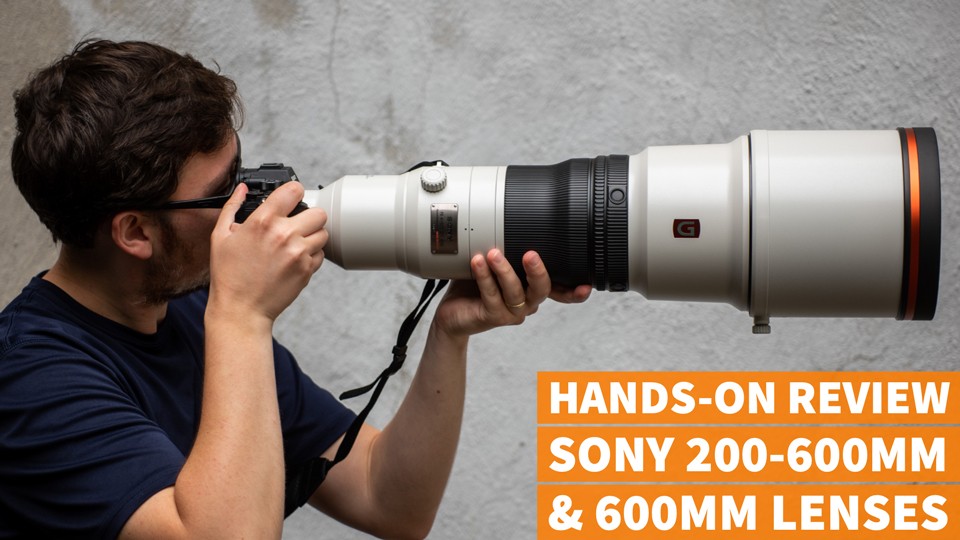
I make the case that these lenses are great news for owners of the APS-C cameras but also for owners of the R full-frame cameras. These lenses offer a viable alternative to using Full Frame glass, for times when the 7R user wants to travel light (the 70-350 is 1/4 of the weight of the 200-600). This is especially useful for A7RIV owners who don’t always need or want to be shooting 61 megapixel files. The added advantage of shooting action/sports in APS-C mode with the A7RM4 is that the buffer increases to 340 compressed Raw files.
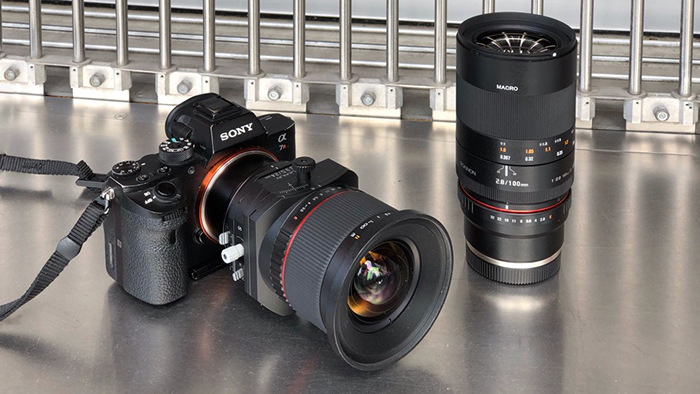
Compared to the 24mm tilt-shift lenses offered by Nikon and Canon, Rokinon’s T-S 24mm f/3.5 ED AS UMC Tilt-Shift lens is nearly identical in size, weight, and tilt-shift abilities. Based on my experience with tilt-shift lenses from each of these companies, I would venture to say Rokinon’s 24mm tilt-shift also comes extremely close to the levels of resolving power one expects from Nikon and Canon lenses. The finish and detail of OEM lenses might best the finish and detail of Rokinon / Samyang / Bower lenses, but at less than half the price, you get a lot of very capable glass for your money.
Engadget tested the A6600 and the conclusion isn’t that favorable:
It’s bizarre that Sony didn’t update the sensor over the last model, considering that it’s the world’s leader in sensor technology. The bad rolling shutter was the biggest weakness of the original A6500, and it’s now back to haunt the A6600. In 2019, it has to compete against the X-T3, Z 50, Canon’s M6 II and Panasonic’s GH5, none of which have rolling shutter that’s nearly as noticeable. I also wish it had two faster card slots and more advanced 4K options.
If you’re looking to spend $1,400, I’d get the X-T3 instead, which is a better all around camera. If it’s resolution you need, take a look at Canon’s M6 Mark II which is cheaper ($1,050 with the EVF) and can also shoot faster. If you’re okay with a smaller Micro Four Thirds sensor, Panasonic’s $1,500 GH5 is still the best video-centric mirrorless camera out there, especially with recent AF firmware updates.
I agree with Steve Dent, the A6600 is surely a highly capable camera but at the moment the Fuji X-T3 has the edge. I do hope Sony will offer a more “serious” contender with improved body design.
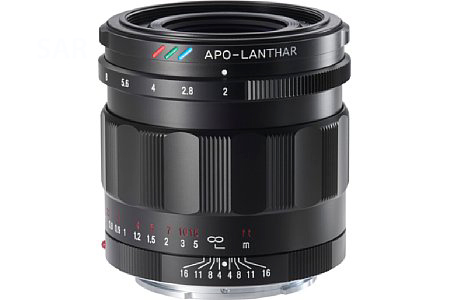
Pity we still didn’t see any English review of this new Voigtlander 50mm f/2.0 FE Lanthar lens. From what I gather in German and Japanese tests this lens performs outstanding. Here is a new review in Japanese:
Used the 600mm prime and 200-600mm lens at the same time has, unfortunately, led to some unfair comparisons. The 200-600mm is not as fast when it comes to autofocus, nor is it as sharp when working wide open. This isn’t to denigrate it—it’s perfectly acceptable, considering its price and standard G branding. I would recommend stopping down a hair when you can and, though teleconverters are a lot of fun, the 1.4x will serve you better than the more demanding 2x that I used.
Everything else about the lens is solid. The lens is weather sealed and feels like it can hold up to enduring some adventures. Optical SteadyShot is very good and works very well with cameras that offer in-body stabilization. Focusing is fast with the DDSSM AF system, and worked very well when tracking subjects. The front element has a fluorine coating that should help keep it clean.