




(SR5) New Sony RGBW sensor coming in compact camera by end of the year!

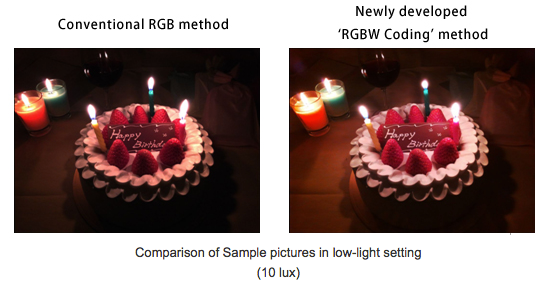
From time to time I post patents describing many new technologies like organic sensors and “foveon” alike vertical alligned pixels and so on. But as you know most of the time these patents just remain….patents. Now many top sources confirmed that there will be a new sensor design made for compact cameras. Sony will launch some compact cameras (with small sensor) by end of the year having a new RGBW sensor. It means it will have Red-Greeen-Blue and White sensible pixels. That new pattern will allow an increased dynamic range. I have no clue yet if that kind of sensor will sooner or later also find his way on larger APS-C an FF sensor. Certainly not within this year!


Maxwell
2 years ago |Not good demo images.
The second image is some lighter but look at the candels.
I see more blown hightlight around the flames in the second image.
So the same result you could maybe get with just +1 EV in exposure
or something.
Aaron
2 years ago |To the average consumer though..
Ohhh! better low light response!
Tore
2 years ago |If you can get the change without changing shutter opening/speed, and without adding high-iso-noise, I would still say it is an improvement
But we’ll see when the products arrive. There are improvements all the time, but they are rarely as big as we wish
Marek
2 years ago |Mother nature shows us how to do it. Similar manner our retina works having dedicated BW sensible rod cells which can detect single photon. I think in the future will see more of this design as number of pixels will grow. It is the way to increase resolution while keeping noise down.
Denis
2 years ago |> Mother nature shows us how to do it. Similar manner our retina works having
> dedicated BW sensible rod cells which can detect single photon. I think in
> the future will see more of this design as number of pixels will grow. It is
> the way to increase resolution while keeping noise down.
The right way is mutlilayer, foveon like technology. I guess there are some technological limitations there, but it’s the best way theoretically: no light loss, ease of use (no more RAW, the TIFF is enough, this will also lead to lagless EVFs — it’s a big deal, since we have many more things to compute, like MF assistants, real time DRO to deal with too deep shadows and overburned skyes, etc). The RGBW still has greater light loss compared to multilayer and has complicated demosaic algorithm.
###
2 years ago |Mother nature shows us spherical sensor with blind spot, variable pixel density, layers of transmitting wires above above sensitive layer, not below, and not so transparent filler between sensor and fix lens with variable curvature.
If you comparing eye with foto camera, then remember that they produce quite different results. Eye is more like 30 fps video camera that does not need sharp image across all frame, only center is valuable.
whistler
2 years ago |Actually – Sonys ability to produce its own sensors is the only thing which currently keeps me on the A-mount. I still think that if they would want, they would release a new FF camera with some ueber cool new sensor tech that will be the D800 killer. If that would happen I could forgive all the disadvantages of the SLT concept and stay with Sony. Will see what the A99 will bring and then make up my mind.
Mustrum Ridcully
2 years ago |The idea itself is good, as Marek stated before. But I’m afraid that this will only be used on ridiculously small sensors with senseless high megapixels (such as the usual 3x4mm sensor with 30 MPix) instead of using it to increase contrast on bigger sensors, too.
Neo NiGHTS ®
2 years ago |But most of the time companies test new technlogies on compact cameras (for obvious reasons). So it only makes sense that those first cameras using this new RGBW technology are compacts.
Sky_walker
2 years ago |AFAIK RGBW sensors aren’t anything new. Kodak got patents on them – I guess Sony bought it on one of patent-sales Kodak made to get up from bankruptcy.
Neo NiGHTS ®
2 years ago |It’s been a couple of years since I’ve started asking about Kodak’s Panchromatic Sensor and no one ever gave me an answer (even here at SAR).
Well, MAY be Sony did buy that patent and that’s why no one else ever spoke about it after its announcement in 2007.
On Kodak’s samples from 2007, though, the images seemed a bit more pale and with more hints of banding.
http://www.dpreview.com/news/2007/06/14/kodakhighsens
Sky_walker
2 years ago |Banding at the time was issue with standard bayer sensors from Kodak too. So honestly I think that Sony version of that would be superior over competition although I still have worries about colors, and I would think 10 times before getting an SLR with such sensor – solely because right now Colors are the best thing in A-mount image quality and I wouldn’t want to loose that.
Neo NiGHTS ®
2 years ago |“solely because right now Colors are the best thing in A-mount image quality and I wouldn’t want to loose that.”
That I have to fully agree. I’ve seen quite a lot of CaNikon shooters praising Sonolta color reproduction.
BTW, is it just me or the Fuji Pro also have muted colors? Although high ISO is excellent, the colors even on low ISO seem a bit off.
passer-by
2 years ago |Sony is known for licensing tech from other vendor like Dynamic Range Optimizer(DRO) from Apical.
decato
2 years ago |Means lower color resolution, probably.
For an 35mm or APS-C sensor it would create some problems with raw flow, like the one with Fuji X1.
Still, new tech is, new tech
Carl
2 years ago |It’ll increase the luminance dynamic range, but will likely decrease the chrominance dynamic range.
Probably not something that’s a worry given the current state of (unnecessarily high megapixel) point and shoot cameras, but it isn’t a technology I look forward to seeing making inroads into the DSLR market.
Sky_walker
2 years ago |Agreed.
But you know what I would like to see in a DSLR? W-type sensor / aka: B&W sensor. A camera that shoots only black and white but has outstanding dynamic range and ISO performance as well as lack of AA sensor. Something to show how good ISOs are possible these days if you get rid of all the filters in front of the sensor.
Leica is supposed to make something like that although… we know the price of it, don’t we
Carl
2 years ago |This could be you: http://leicarumors.com/2011/07/09/leica-store-in-moscow-robbed.aspx
Though I do wonder why the pictures of the damage were so poor given the store involved.
butch
2 years ago |wander how many 16mp B&W bodys would sell tho and at what price point (i can see how some would liek to have this option )
i woudl think it would be fun to play with but for me right now not worth 700+$
as much as i woudl rather have it an A mount it might be better to make a short run limited edition of the nex 5n (could always get the asmount adapter)
Sky_walker
2 years ago |It really depends on how it’s made. If it’d be cheap DSLR-alike body with MR mode and a large EVF but no magnesium-alloy body or any techy stuff nor video – it could go down with price by quite a bit, I’d say probably even below the level of A57. You know: Purely photographic tool aimed towards ultimate DR and ISO (so: no 24 MPx APS-C sensor). It could give Sony a lot of praise, as company now suffers a little bit for not-having a camera-maker badge on it. This would change a situation by a bit IMO.
Denis
2 years ago |Not interesting. Colors will suck even more than ones of Fuji XPro-1. May be good for PS, though, with their diffraction limited sensors.
passer-by
2 years ago |Maybe just like human eye, the color sucks only in low light. Still better than see nothing at all.
Pictus
2 years ago |This white pixel remember-me of Fuji R-pixel http://www.dpreview.com/news/2003/1/21/fujisuperccdsr
The OLD S5 Pro was the king of the dynamic range for a long time…
http://www.dxomark.com/index.php/Cameras/Camera-Sensor-Ratings/%28type%29/usecase_landscape
LifeStoryImages.com
2 years ago |This IS a technology that you will see in future SLR sensors, once it matures.
John Hedgecoe
2 years ago |Wasn’t this a Kodak idea? Anyway, the sensor improves low light response, but at the expense of color accuracy. I think the original intention was for use in cell phones.
In any event, it is highly unlikely this sensor will appear in any large sensored camera due to the lack of color accuracy.
Boooe
2 years ago |To shoot in low light is one of causes why I bought a NEX. Even with f/2.8 lens, still need to use ISO3200 indoors.
I think a very slight IQ degradation in daylight landscapes is insignificant compared to the advantages of RGBW: less moire, less noise, greater DR, faster autofocus & brighter liveview. Would be great if LCD, EVF, and sensor used the same RGBW pattern!
wth
2 years ago |Wait…. Something is really wrong with the picture!?!?!?
How come it isn’t taken with a Nikon Camera????
I thought Sony is meant to sell all their new Sensor technology to Nikon first?