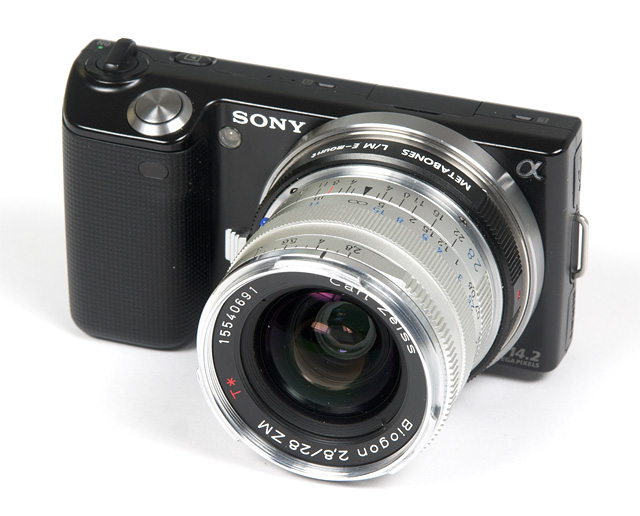





Zeiss Biogon 28mm and 35mm lenses tested on the NEX-5 (Photozone)

Image courtesy: Photozone.
Let’s have some break from rumors! Klaus from Photozone (Click here) tested the Zeiss Biogon 28mm manual lens on the NEX-5: “The Zeiss Biogon T* 28mm f/2.8 may be a star on Leica M film cameras but it struggles somewhat with the Sony sensor in the NEX-5. The image quality is pretty much breathtaking in the image center but the border performance is actually much less impressive and in fact quite soft at large aperture settings. The border quality improves to very good levels (just) when stopping down though.”
The Zeiss Biogon is an M-mount lens and you will need an M to E mount adapter to use it on a NEX (Click here to see these adapters on eBay). The lens itself costs around 800-1000 Euro/Dollars (Click here to see the lenses on eBay).
UPDATE: And today Photozone (Click here) tested the 35mm Biogon: “The Zeiss C Biogon T* 35mm f/2.8 is supposed to deliver great images on film but it doesn’t really harmonize well with the Sony sensor of the NEX-5. The center image quality is simply great even at max. aperture but the border resolution is somewhat disappointing especially considering the moderate base aperture. The borders are still good (just) at f/2.8 and increase steadily till f/8 towards very good (just) results.” The lens has the same price as the before mentioned 28mm biogon (Click here to see the 35mm BIogon auctions on eBay).

matgay
10 months ago |I like photozone.de site, but they should really have a ratings systems that will quickly lists all the lenses according to points, and sort by options. It shouldnt be too hard at all to do. Please photozone.de
genotypewriter
10 months ago |Rating systems are meaningless and are only good for who people don’t understand how lenses can be used.
It’s a lot better to understand the limitations of these tests and how lenses/cameras behave under different conditions. But that’s the best way… not necessarily the easy way
emopunk
10 months ago |Disappointing. I see in this what I have been reading in last days comments concerning e-mount flange distange and corner performance of glasses.
ItsaChris
10 months ago |because there is an converter from E-mount to m-mount the flange distance is no longer the 18mm that is on the e-mount but the 25mm (?) long that all m-mount cameras are. Off axis light rays effect digital sensors more than film, but you see the same problems in the m9 as well (and if you look up some test you can see how much worse it is).
frosti7
10 months ago |Thats why sony must develop a native 30-35mm lens!
Like in this petition:
http://www.petitiononline.com/mod_perl/signed.cgi?NEX30mm
emopunk
10 months ago |I would also say that’s why Sony should invest and push hard on A-mount, instead of weakening R&D power on all kind of attempts.
Eric
10 months ago |I’m with you. The Zeiss 24mm is fine, but I would much prefer either a 28mm f/2 or a 30mm f/2. That is if Sony is actually capable of making a good quality small fast standard prime. I’m really starting to have my doubts after seeing the size of the Zeiss 24mm.
After reading they were surprised enthusiast were interested in the NEX system I’m starting to wonder if they have any actual photographers on staff there. If they do have any surely one of them has had to point out that a 42-50mm equivalent prime is a necessity of any system.
Edward
10 months ago |It would be interesting to see how these lenses would perform on the new Nex bodies. There evidence that from now on, as in the Nex c3, the corner pixels have been optimized for oblique rays. People who purchased this cam have reported sharp corners with the 16/2.8 and ZM lenses. The Nex 7 will also benefit from this development. It is very unfair at this time to keep on testing these lenses on the older sensor technology, especially that these Nex models are discontinued.
Nico
10 months ago |Exactly, and it will be the case for the Nex-7, even more with 24mpx sensor !
But, in fact when you take pictures (as I do) with the Nex-5 and ZM or M lenses you hardly notice those things, it’s a labs matter….
In “real photography world” when you want sharp corners of course you stop down !
Jiri
10 months ago |It might be a problem of the particular lenses only and not of the e-mount flange distance. Photozone has also tested the Zeiss Biogon T* 35mm f/2 ZM on NEX(http://www.photozone.de/sony-alpha-aps-c-lens-tests/555-zeisszm35f2nex) and their conclusions were quite different:
“MTF (resolution)
The Zeiss lens delivers a very impressive resolution across the tested aperture range. The center quality is already very good at f/2 the borders follow on a good+ level here. The center performance is lifted into excellent territory from f/2.8 onwards and the borders reach very good figures starting at this setting.”
The Biogon T* 35mm f/2 is of course more expensive …
Nico
10 months ago |+1
And that’s why Fuji with the X100 and Leica on M’s digitals use micro-lenses to optimize the sensor with wider lenses (<35mm)…
Edward
10 months ago |The problematic corners on the older cams have been reported only with lenses wider than 35mm, so I would expect the ZM 35/2 to perform better.
Jiri
10 months ago |This is exactly what I am interested in. I have been using the A100 with Tamron 11-18mm for five years now. The results were not fascinating, but quite sufficient for my purposes (architectural documentation). The wide and ultra wide focal length lenses are what I will use mostly. I have no experience with the NEX system, but I would like to by the NEX-7. If it really has a customized sensor and built-in optical compensation as mentioned in the rumors the problems with a lower corner performance could be reduced.
michel v
10 months ago |It can still happen with 35mm lenses. My Color Skopar 35mm needs some Cornerfixing (though less than its 28mm counterpart).
Gunnar
10 months ago |honestly i have a hard time imagining why those lenses should behave any better on any other sensor or film, as the sensor can hardly be the cause for blur and that even just for certain apertures. i would understand if the sensor was to blame for heavy vignetting as it has no microlenses and therefor the border photocells catch light of oblique rays less efficient. ..would have been interesting to seen a comparison of those lenses on a different sensor or film. but it simply show, you cant have it all
deniz
10 months ago |not blur maybe but CA?
Steve Jones
10 months ago |The sensor can be the cause of blur as it’s a complex 3-D sandwich. In this case a combination of IR, AA & Bayer filter and micro-lenses. With short focal length lenses designed for a short register the rays arriving at the extremities have an incident angle a long way from the vertical which means they pass diagonally through this 3-D sandwich. From this you get colour shifts, fringing and blurring. Leica specially tweaked their M series to reduce this (including software tricks), but even those aren’t 100% effective.
Ideally all lenses for digital cameras would be near telecentric – that is designed to incident rays are at 90 degrees to the sensor “sandwich”. However, that isn’t going to happen with legacy lenses (or “pancake” designs). There are some things that can be done – thinner filter “sandwiches”, angled micro-lenses, software tweaks to deal with fringing, colour shifts and vignetting, but some of these will only work fully if the lens & sensor designs are produced with the same parameters.
So, if until somebody designs a true 2-D sensor without that “sandwich” (and not even a Foveon fits that bill), issues with severely non telecentric lenses will occur. They are likely to be worse on wide-angle lenses designed for film cameras with short registers, which pretty well defines the M series mount.
Edward
10 months ago |I am not making this up. I don’t want to delve into technical stuff as I am no engineer. But there is a fact: the corner blur is gone on the Nex C3.
emopunk
10 months ago |Can you provide any proof of what you say?
Edward
10 months ago |http://forums.dpreview.com/forums/read.asp?forum=1042&message=39049114
emopunk
10 months ago |Well, it’s still voices.. Better to wait for some in depth review of the final product, I guess.
Valdemar
10 months ago |Check the links provided, the 3rd one has some great samples of the colour vignette reduction that the C3 does. It looks better than Leica M9 solution.
I’ll paste that thread again:
http://www.fredmiranda.com/forum/topic/1030741
El Aura
10 months ago |I am wondering whether on top of the offset placement (which reduces colour shifts and vignetting) you might have to make the microlenses themselves optically different (asymmetrical) to get good corner performance with very short flange distances.
Steve Jones
10 months ago |More evidence that designing sensors for short registers with wide-angle lenses is difficult, especially if the lens in question was designed for film (and the register in question here is the M mount). Leica, themselves, have struggled with this. Generally speaking, lenses designed for SLRs will exhibit less of this as the necessary retro-focal designs seem to be less afflicted.
It may be that newer sensors can be designed with thinner IR, AA & Bayer filter “sandwiches” which are less prone to this effect.
Whatever
10 months ago |Well, the lenses in question work fine on the Leica M9 and M8. So I think it’s the mircrolenses issue.
SRL
10 months ago |Yes,
There are many fine cameras and lenses that provide better overall performance, right?
It seems that many posters and fanboys are demanding a camera the size of a pack of cigarettes and a lens that matches in size that is pleasing to the poster eye and maybe it’s just not going to happen with this product.
Could it be possible that this particular architecture (NEX body & current lens designs) is not ready to surpass the current bigger body format to produce corner to corner sharpness?
Whatever
10 months ago |The MFT solution to this was to use software correction, which is regarded as a heresy by some. Funny enough, Leica uses software correction, and I heard Nikon does as well.
Rubens
10 months ago |I use the nex 3 and leica M9. There a distinct difference in image quality. I blame the AA filter but it might be more than just that… But with the nex I can focus closer than MFD so its good. Hoping the Nex 7 is good. I have high hopes for it.
Michael
10 months ago |“…NEX-7…Sony, I’m told, has struggled a bit with getting good corners because of the short registration distance. Sony originally planned for the NEX to be marketed at consumers and didn’t realize it would be a hit with enthusiast too. To combat the short registration distance, they put in some micro offset lenses. All lenses will benefit from this, including legacy glass so people will see improved performance with their rangefinder lenses…”
If the report is right, we should see better corner performance of Zeiss M mount lenses on NEX-7. And don’t forget Zeiss’s Contax G lenses, those marvelous little lenses are perfect for NEX-7. Get one before the prices are driven up.
Alfonso Cuitiño
10 months ago |I once thought of moving to MFT… but it’s got a 2x crop sensor! c’mon! NEX forever <3 lol
Jojo
10 months ago |The short register of the E mount does introduce another lens design problem, but it is not a factor here. The adapter places an M mount lens at the correct register distance for which it was designed. The difference seems to occur within the layers (micro lenses, filters, etc) of the sensor. Light losses increase vignetting, there can be colour shifts, there could possibly even be a reduction in contrast that would affect sharpness, but are we saying that resolution can be reduced by the sensor?