New Sony A7V youtubers roundup!
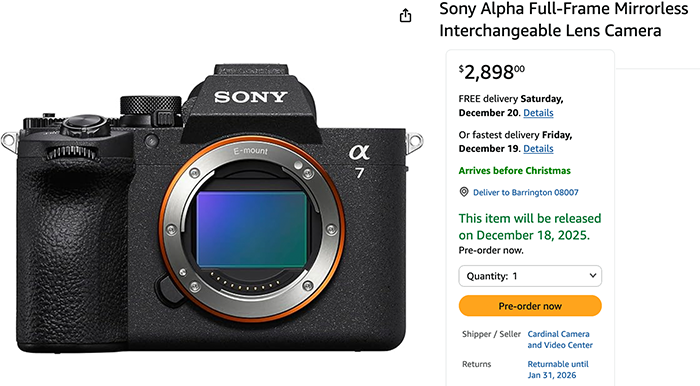
Sony A7V preorders:
In USA at at BHphoto, Amazon, Adorama, Henrys.
In EU at Fotokoch, FotoErhardt, Calumet, Foto Köster, WexUK, Clifton, Park UK, Fnac FR.
In Australia at: Camera Pro, Sony Australia.
Sony A7V preorders:
In USA at at BHphoto, Amazon, Adorama, Henrys.
In EU at Fotokoch, FotoErhardt, Calumet, Foto Köster, WexUK, Clifton, Park UK, Fnac FR.
In Australia at: Camera Pro, Sony Australia.

A couple of European SAR readers told me their Sony A7V preorder shipped out yesterday/today.One of our readers (Thanks!) just sent me this:
Ok here I am again from the Netherlands.
I received the A7V today!Also, I’ve seen some talk about third-party lens support. All my third-party lenses are working.
Tamron 35-150mm
Sigma 60 600 mm
Sigma 56mm 1.4 DC DN (apsc)
Even de viltrox af 15/1.7 (apsc)
Could be that the shipped Sony A7V come with final firmware installed that gets rid of the issues reported by Kai in his video.
Sony A7V preorders:
In USA at at BHphoto, Amazon, Adorama, Henrys.
In EU at Fotokoch, FotoErhardt, Calumet, Foto Köster, WexUK, Clifton, Park UK, Fnac FR.
In Australia at: Camera Pro, Sony Australia.
Sony A7V preorders:
In USA at at BHphoto, Amazon, Adorama, Henrys.
In EU at Fotokoch, FotoErhardt, Calumet, Foto Köster, WexUK, Clifton, Park UK, Fnac FR.
In Australia at: Camera Pro, Sony Australia.
DC.watch quickly tested the Sony A7V and writes:
It essentially gives mainstream photographers some of the α1 / α9 III intelligence, but at less than half the price.
Here are the bullet points:
The french Phototrend website writes:
Overall verdict: a highly capable, versatile stills camera with class-leading AF and strong performance in most scenarios, but a bit “timid” versus rivals for demanding video shooters.

Ah no sorry..this Sony A7v is “Open” and not “Open Gate” :)
P:S.: Spotted at the Sony China launch event
Sony A7V preorders:
In USA at at BHphoto, Amazon, Adorama, Henrys.
In EU at Fotokoch, FotoErhardt, Calumet, Foto Köster, WexUK, Clifton, Park UK, Fnac FR.
In Australia at: Camera Pro, Sony Australia.


Sony A7V preorders:
In USA at at BHphoto, Amazon, Adorama, Henrys.
In EU at Fotokoch, FotoErhardt, Calumet, Foto Köster, WexUK, Clifton, Park UK, Fnac FR.
In Australia at: Camera Pro, Sony Australia.
Sony A7V vs Canon R6III (full spec comparison on this BH page)
It’s time to make the big discussion: Sony A7V vs Canon R6III. Now one thing has to be made clear: Both are EXCELLENT cameras and nobody should switch system because of “one” camera. But let’s get into the bitty gritty and highlight the differences between the two
1) Sony’s fundamental architectural advantage:
“The Sony A7V uses a more modern, faster sensor architecture (partially stacked vs. Canon’s non-stacked design) and a newer processor with integrated AI. This gives Sony far more headroom for future features added through firmware updates than Canon currently has. In other words, the A7V has significantly greater upward potential that Sony could — and hopefully will — take advantage of. Any missing features today (such as Open Gate) are, at least on paper, well within the camera’s capabilities. Now we just need to push Sony to actually deliver them.”
this is point nearly nobody highlighted: The Canon is based on a regular architecture while Sony has gone all in with a very future proof hardware.
2) Sony is the king of speed:
The devil is always in the detail: While Canon can read out at 13.5ms and the Sony at 15.1ms, the Sony does it in full 14 bit while Canon has to reduce the amount of data with a 12 bit readout. This allows Sony to have an impressive 1+ stop advantage in dynamic range over the Canon! 40fps in lower quality of the Canon is in my opinion not a match for the 30fps 14bit RAW of the Sony.
3) Sony has the edge in still-image quality:
Sixteen stops of dynamic range sounds impressive, and I’m looking forward to proper tests that can confirm whether Sony’s still-image quality now pulls ahead of Canon.
4) Canon wins in video
Canon has 120p uncropped, Open Gate, waveform, false color, 7k. internal RAW recording. Sony’s only advantage is much less overheating issues. Now, Sony has the margin (speed on the sensor è power on the processor) to improve the video features through future updates. Let’s see if they can close the gap with Canon.
6) Autofocus (to be tested)
Canon has 100% coverage but I suspect Sony will have a more useful, faster and accurate AF system than the Canon. This has to be confirmed via proper testing!
7) Ergonomics and other features
This is mostly a personal preference. The Canon is bigger and maybe easier for some to handle. I personally love the compact size of the Sony A7V. I love their 4 way fully articulating screen. I also found it impressive that the Sony can offer much longer battery life than the Canon
PetaPixel writes:
Before this camera’s announcement, I would have given the best camera of the year to the Canon EOS R6 III. I still might, but the Sony a7 V is easily a contender for this prestigious title.
From a purely photographic standpoint, I think it has minor advantages over the Canon in terms of image quality and focus performance. However, I believe that the Canon is slightly more compelling as a hybrid photo/video product.
Essentially, we have two cameras that are very close in their main specs (33MP resolution, excellent 4K recording), each with its own strengths in specific areas. I feel that Sony has greater potential for growth — but only if Sony recognizes this and is willing to add new features through future firmware updates.

Sony A7V preorders:
In USA at at BHphoto, Amazon, Adorama, Henrys.
In EU at Fotokoch, FotoErhardt, Calumet, Foto Köster, WexUK, Clifton, Park UK, Fnac FR.
In Australia at: Camera Pro, Sony Australia.
–
Here is a spec comparison between the “old” Sony A7iV and the new Sony A7V. It doesn’t also mention some other differences like less overheating, faster autofocus performance, new AI white balance and other minor improvements:
| Category | ILCE-7M5 (A7V) | ILCE-7M4 (A7 IV) |
|---|---|---|
| Image Sensor | ||
| Sensor size | Full size | Full size |
| Sensor type | Partially laminated type | Back-illuminated |
| Effective pixel count (megapixels) | Approximately 33 million pixels (Note: 16 stops dynamic range) | Approximately 32.7 million pixels (15 stops dynamic range) |
| Maximum recording pixels | 7008 × 4672 | 7008 × 4672 |
| Aspect ratio | 3:2, 16:9, 4:3, 1:1, APS-C | 3:2, 16:9, 4:3, 1:1, APS-C |
| Low-pass filter | Mounted | No information |
| Image stabilization | 7.5 rows in the center, 6.5 rows around | 5.5 |
| Dust removal function | Shutter closing function | Anti-static coating, Sensor shift |
| Read speed | 1/67.5 s | 1/15 s |
| Low light ISO | No information | 5365 |
| PDR | No information | 11.71 |
| Processor | ||
| Image processing engine | BIONZ XR2 | BIONZ XR |
| RAW output format | Supports 14-bit 30fps, Lossless compression, Image quality priority, Compression | 14-bit compression, Lossless compression (L/M/S), Uncompressed |
| Other outputs | HEIF | HEIF |
| Recording media | SD UHS-II, CFexpress A | SD UHS-II, CFexpress A |
| Media slot | 2 (CFeA slot1) | 2 (CFeA slot1) |
| Movie | ||
| Video recording format | MPEG-4 AVC/H.264, MPEG-H HEVC/H.265 | MPEG-4 AVC/H.264, MPEG-H HEVC/H.265 |
| Audio recording method | LPCM | LPCM, AAC |
| Recording format | XAVC S, XAVC SI, XAVC HS, 4:2:2 10-bit | XAVC S, XAVC SI, XAVC HS, 4:2:2 10-bit |
| 4K | ~120p, ALL-I/LGOP, ~600 Mbps | ~60p, ALL-I/LGOP, ~600 Mbps |
| FHD | ~120p, ALL-I/LGOP, ~222 Mbps | ~60p, ALL-I/LGOP, ~222 Mbps |
| Video crop | None (4K 60p), S35 (4K 120p) | None (4K 30p), S35 (4K 60p) |
| Continuous shooting time | Unlimited | Unlimited |
| Time-lapse video | – | – |
| Video recording function | Skin Beautification Mode, Gamma Display Assist, Focus Map, Breathing Compensation | Skin Beautification Mode, Gamma Display Assist, Focus Map, Breathing Compensation |
| Video profile | PP, S-Cinetone | PP |
| Electronic image stabilization | Active (4K 120p compatible), Dynamic Active | Active |
| Proxy | Correspondence | Correspondence |
| Timecode | Correspondence | Correspondence |
| Anamorphic | – | – |
| Drive | ||
| Shutter speed | 1/8000–30 seconds | 1/8000–30 seconds |
| Electronic front-curtain shutter | 1/8000–30 seconds | 1/8000–30 seconds |
| Electronic shutter speed | 1/16000–30 seconds | 1/8000–30 seconds |
| Flash sync | 1/250 s (full size), 1/320 s (APS-C size) | 1/250 s (full size), 1/320 s (APS-C size) |
| High-speed continuous shooting | Electronic shutter up to approximately 30 fps maximum, approximately 10 fps mechanical shutter (14-bit compatible) | Up to 10 frames per second (compressed RAW), 6 frames per second (uncompressed RAW) |
| Number of continuous shots | RAW: 95 frames, Lossless: 35 frames | 6 fps RAW: 1000, Uncompressed RAW: 1000 |
| Low speed limit setting | Supported, auto adjustment | Supported, auto adjustment |
| Pre-continuous shooting function | Up to 1 second ago | – |
| Self-timer | 2/5/10 seconds | 2/5/10 seconds |
| Other drive features | Continuous shooting speed boost, Blackout free | |
| Viewfinder / Monitor | ||
| Viewfinder method | 0.5 type OLED | 0.5 type OLED |
| Viewfinder resolution (dots) | 3.69 million dots | 3.69 million dots |
| Eyepoint (mm) | Approximately 23 mm | Approximately 18.5 mm |
| Maximum viewfinder magnification | Approximately 0.78 times | Approximately 0.78 times |
| Diopter adjustment range | -4 to +3m-1 | -4 to +3m-1 |
| Fluorine coating | Correspondence | |
| Frame rate | 60/120 fps | 60/120 fps |
| Monitor format | TFT color | TFT color |
| Monitor resolution (dots) | 2.1 million dots | 1.04 million dots |
| Monitor size | 3.2-inch | 3.0 type |
| Movable method | 4-axis tilt | Vari-angle |
| Touch panel | Correspondence | Correspondence |
| Interface | ||
| Digital terminal | 1: USB-C USB3.2 10Gbps, 2: USB-C USB2.0 | USB 3.1 Gen2 Micro B |
| Special terminal | – | – |
| Sync terminal | – | – |
| HDMI terminal | A | A |
| External microphone jack | 3.5mm | 3.5mm |
| Headphone jack | 3.5mm | 3.5mm |
| Remote control terminal | – | USB Micro B RM-VPR1 |
| Wireless remote control | RMT-VP2 | RMT-VP2 |
| Wi-Fi | 802.11a/b/g/n/ac/ax | 802.11a/b/g/n/ac |
| Bluetooth | 5.3 | 4.1 |
| NFC | – | – |
| GPS | – | – |
| Environmental sensors | – | – |
| Tethered shooting | Imaging Edge | Imaging Edge |
| Flash | – | – |
| Electronic level | 2-axis | 2-axis |
| Drawing function | ||
| HDR shooting | – | – |
| Multiple exposure | – | – |
| Interval shooting | – | – |
| High-resolution photography | – | – |
| Bracket | AE/WB/DRO | AE/WB/DRO |
| Other features | Composite RAW shooting | |
| In-body RAW development | – | – |
| Lens correction | Peripheral illumination, Chromatic aberration, Distortion, Breathing | Peripheral illumination, Chromatic aberration, Distortion, Breathing |
| Color presets | 12 types (FL2/FL3), PP, S-Cinetone | 10 types, PP |
| Finishing settings | Custom 6 frames, Contrast ±9, Shadow ±9, Highlight ±9, Fade ~9, Saturation ±9, Sharpness ~9, S.Range ~5, Clarity ~9 | Custom 6 frames, Contrast ±9, Shadow ±9, Highlight ±9, Fade ~9, Saturation ±9, Sharpness ~9, S.Range ~5, Clarity ~9 |
| White balance | Auto (3 types), Sun, Shade, Cloudy, Incandescent, Fluorescent (4 types), Flash, Color Temperature (2500–9900), Color Filter, Custom (3 frames), Underwater Auto (Ai driven) | Auto (3 types), Sun, Shade, Cloudy, Incandescent, Fluorescent (4 types), Flash, Color Temperature (2500–9900), Color Filter, Custom (3 frames), Underwater Auto |
| Digital filter | – | – |
| Power supply and body | ||
| Battery | NP-FZ100 | NP-FZ100 |
| Vertical grip | VG-C4M | VG-C4M |
| USB charging | USB-PD | USB-PD |
| USB powered | USB-PD | USB-PD |
| Number of photos that can be taken | 630-image EVF, 750-image LCD | 520-image EVF, 580-image LCD |
| Videos that can be recorded | Approximately 210 minutes EVF, Approximately 210 minutes LCD | Approximately 170 minutes EVF, Approximately 175 minutes LCD |
| Body material | Top, Front, Rear, Internal frame | Top, Front, Internal frame |
| Body size width (mm) | 130.3 | 131.3 |
| Body size height (mm) | 96.4 | 96.4 |
| Body size depth (mm) | 82.4 | 79.8 |
| Weight (including media and battery) | Approximately 695 g | Approximately 658 g |
| Mass (body only) | Approximately 610 g | Approximately 573 g |
| Dustproof and waterproof | Considerate design | Considerate design |
| Operating temperature | 0°C to 40°C | 0°C to 40°C |
| Autofocus | ||
| AF method | Hybrid | Hybrid |
| Ranging point | 759 points | 759 points |
| Coverage area | Approximately 94% | Approximately 94% |
| Distance measurement brightness range | -4 to 20 (F2 lens) | -4 to 20 (F2 lens) |
| Focus mode | AF-S, AF-A, AF-C, DME, DMF, MF | AF-S, AF-A, AF-C, DME, DMF, MF |
| Distance measurement area mode | Wide, Zone, Center, Flexible (XS/S/M/L/XL), Expandable Flexible, Custom, Lock-On | Wide, Zone, Center, Flexible (S/M/L), Extendable, Lock-On |
| Face detection | Correspondence | Correspondence |
| Eye detection | Eye AF, left/right switching supported | Eye AF, left/right switching supported |
| Customizable tracking characteristics | Tracking Sensitivity | Tracking Sensitivity |
| Subject detection function | Auto, People, Animals, Birds, Insects, Cars, Trains, Airplanes | Animal eyes, Bird eyes, Real-time tracking |
| Midfielder assist | Peaking, Focus Map | Peaking, Focus Map |
| Exposure | ||
| Photometry method (divisions) | 1200 divisions | 1200 divisions |
| Photometry method (patterns) | Multi, Center-weighted, Spot, Wide-screen average, Highlight-weighted | Multi, Center-weighted, Spot, Wide-screen average, Highlight-weighted |
| Photometric range | -3 to 20 | -3 to 20 |
| Exposure mode | AUTO, P, S, A, M, C3 frame | AUTO, P, S, A, M, C3 frame |
| Regular ISO sensitivity | 100–51200 | 100–51200 |
| Extended ISO sensitivity | 50, 204800 | 50, 204800 |
| Exposure compensation | ±5.0 EV | ±5.0 EV |
| Flicker reduction | Correspondence | Correspondence |
| DR correction | 5 stages | 5 stages |


via Asobinet
Sony A7V preorders:
In USA at at BHphoto, Amazon, Adorama, Henrys.
In EU at Fotokoch, FotoErhardt, Calumet, Foto Köster, WexUK, Clifton, Park UK, Fnac FR.
In Australia at: Camera Pro, Sony Australia.
PetaPixel listed the 15 biggest improvements on the Sony A7V:
In my opinion, this is a solid upgrade — especially because the fundamentals are now much stronger: a new sensor and a new CPU with an integrated AI chip. With that foundation, there’s real potential for Sony to introduce additional features through future firmware updates.