



Rhino Cam helps you to create 140+ megapixel photos with your NEX camera.

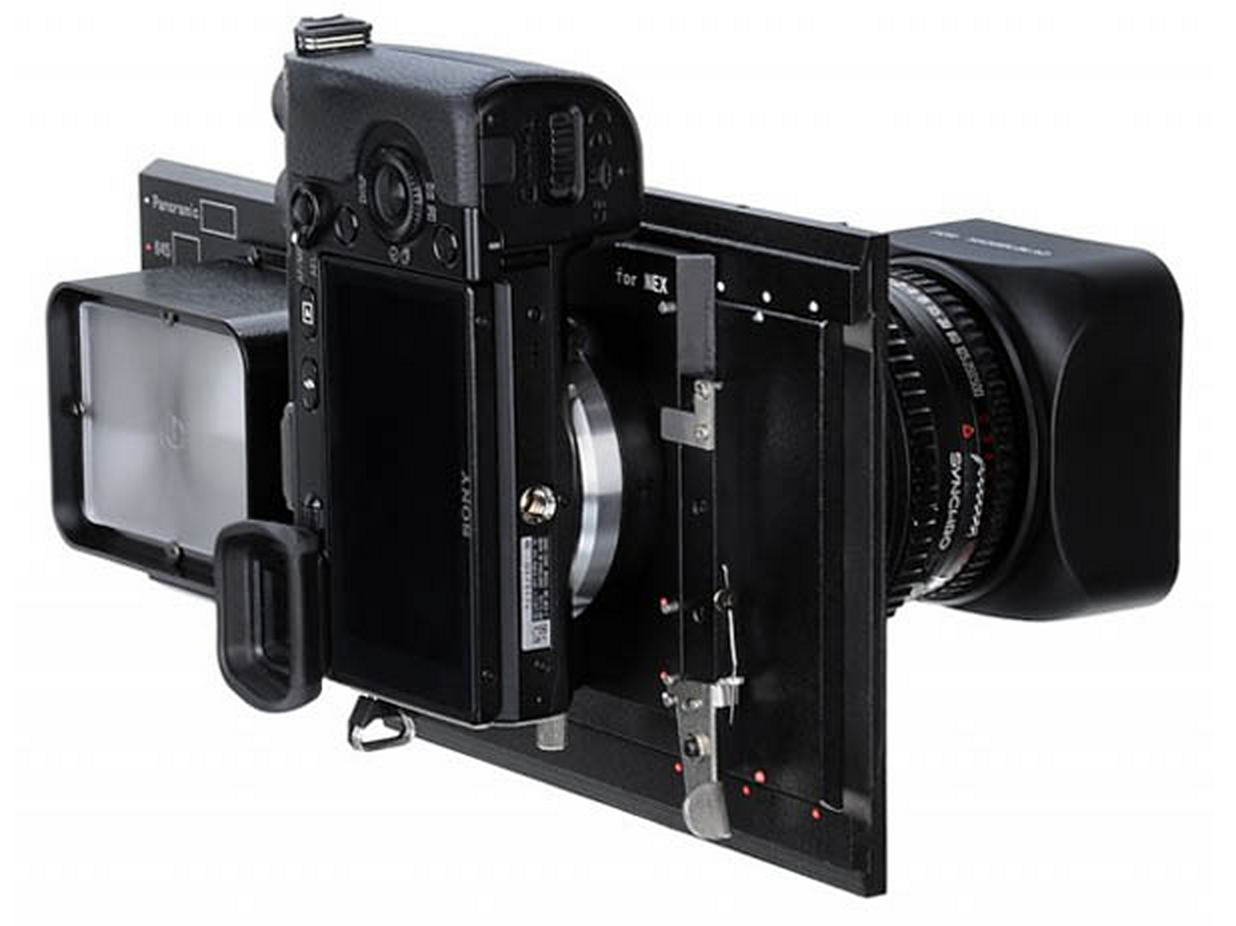
Rhino Cam (Click here) created a sort of medium format adapter that uses a Sony NEX camera to make a scan of the image created through a classic medium format camera. In short, you put the adapter between the NEX camera and the Pentax 645 or Mamiya 645 or Hasselblad V medium format lens. The NEX camera moves to take multiple shots from the medium format area (62,4 x 46,8mm). Than you just have to stick the images together to have your 140+ megapixel photo. It’s a sort of “panoramic mode” for medium format cameras

Yep, it’s a bit like having a digital back but of course this solution works on still objects only! It’s priced at $499 and you can order it here: Fotodioxpro.com.
And here are the medium format lenses you can use with it:
Pentax 645 lenses on eBay (Click here).
Mamiya 645 lenses on eBay (Click here).
Hasselblad V lenses on eBay (Click here).
found via PetaPixel.


DaveT
3 months ago |Hmmm. I have 2 NEX cameras and a Mamiya 645…might be worth looking into.
Looks like you might have destroyed the Fotodiox site though…it’s broken at the moment.
animalsbybarry
3 months ago |Wouldnt it be simpler if sony could actually give us a high megapixel camera
DaveT
3 months ago |Given what an 80MP digital back costs, I’m not sure I’d buy one…that’s why I still shoot film. I can develop a lot of rolls of 120 for $30,000+
animalsbybarry
3 months ago |MORE PIXEL POWER !!!
Rob
3 months ago |We already stitch images together for gigapixels – so this means nothing. What’s missing is a higher resolution camera for one-click large format images. C’mon Sony, you can do it. Don’t just go after Leica M with a FF Nex – you can take down Phase One with their $30-$40,000 MF backs (no lenses included) or Hasselblad. Keep the teck to yourself, and take a chunk out of Nikon too (but you’ll have to significantly exceed 36 megapixels). Those of us who love high rez images would be grateful!!
xxxx
3 months ago |No, stitching distorts picture.. this thing is kinda “shift” movement with the view camera. All you have to do is align the pictures and you’re done. No pixel degradation…
Spuds
3 months ago |So long as the world stops moving, and I mean everything; no trees swaying, no bird flying by, no earth spinning…. Absolutely no movement and this would be a great idea….. But that never happens so in the end you will have issues…. Multiple birds from only one flying past, variations in shadows from clouds passing, tree limbs that don’t line up perfectly between patches… Sorry but not worth it for the price.
Tom S.
3 months ago |Depending on how fast it is to shift, it would work well for architecture, macro photography in highly controlled environments etc. Possibly astro-photography w/proper alignment equipment. Agreed it seems like a pretty narrow field though.
LifeStoryImages.com
3 months ago |Finer pixels is only a part of the puzzle. I like what they’ve done here: For those with an MF camera and lenses already, they put the large image plane to use quite nicely. In effect having a MF-shift-lens.
I’ve done many a panoramic, 250MP up to 2GP using standard lenses. The difference is that the conjugate object plane does not stay parallel shot to shot.
FYI, Stitching doesn’t distort images when the apropos projection is selected.
FK
3 months ago |A FF Nex wouldn’t be anywhere near a Digital Medium Format Camera. In fact it is playing in an totally different league.
Taking a look at this product you have to say that it has an extremely reduced functionality in comparison to a MF or FL system no matter if on Film or Digital. That it wouldn’t be able to produce anything useful with even slowly moving Objects should be clear from the beginning. Then let’s assume you want to use it in a studio let’s say for product photography. You will then have a problem with your Flashes, if the Cam Shoots to Fast some frames won’t be lit and due to the way Flashes work some times the Flashes fire slightly weaker or stronger at the same setting so you will end up stitching images slightly differentiating in luminance.
ddueck
3 months ago |Cool adapter, but if you have to use software to stitch the images, and your subject isn’t moving, you can always just use a fast lens with the Brenizer method (http://goo.gl/CXpy5) for a similar effect. Here’s a photo I did with my NEX-7 and Rokinon 35/1,4 using that method and it’s quite easy.
http://goo.gl/Fz5Di
pjpo
3 months ago |Exactly. I’ve shot using Brenizer method with my Rok 85mm for the same effect. No big deal here.
MC
3 months ago |I think this is a good idea. I used to know a photographer John Choy in Hong Kong. He told panorama photos and VR photos by NEX. His photo is amazing and he has to take 70+ photos per photo and stitch them up since some environment is with moving object. They use the similar concept by Rhino Cam help us to capture image in a fixed image circle while John use panorama ball head that may create some perspective change. But the main concern is that the resolution of medium format lenses should not be sharp enough to deliver good detail than the modern designed lens. That’s the main struggle for me.
MC
3 months ago |FYR, John Choy’s photo can be found here:
http://www.johnchoy.com/
CTPhotographX.com
3 months ago |May should also consider the Mirex T/S adapter. Provides T/S in a most compact manner, and can be used for A-Mount too. Plays nice with Mamiya 645 glass. I can’t fathom how a tripod can be used in the display above.
DaveT
3 months ago |If you check the photos on the Fotodiox page you’ll see a tripod foot just like on their lens adapters. It’s going to wobble some. That’s my only concern with the system. The stitching will still work if the image isn’t perfectly aligned in each photo…but you sometimes need long exposures for landscape and architectural so this may or may not be good for that.
JoeNoName
3 months ago |man, with my 12megapixel a500 ive done photos of up to 197megapixels, nothing new, just stitch them with your favourite software and be carefull with the PARALLAX.
0 money invested, be carefull and plan well your shots.
BlackLegSanji
3 months ago |That’s the whole point of this device, no? You don’t have to worry about parallax.
JoeNoName
3 months ago |so pay $500 for something that you can handle, therefore itll be free?
…
BlackLegSanji
3 months ago |So why pay hundreds of $ more for a lens which has less distortion, less chromatic abberation, less vignetting etc…when you can fix those problems in post?
Sky_walker
3 months ago |I think you don’t understand what it is.
It’s NOT a lens. Marley an adaptor.
ON TOP OF THAT you need to buy medium format lens – cheap, used one usually runs over 1000 GBP. But you don’t want cheap – you want good lens that will handle high pixel density. That’s way above 1000 GBP (and it still does have optical distortions, despite of what you suggest)
Now… you buy proper tripod head for panoramic shots that can be used A500, a good lens with almost no CA, vignetting or distortions (assuming you don’t have one – most of the people interested in serious shooting got few of these though, so here you save even more money)), and do it yourself. 140 MPx city panorama… or even over GPx if you got longer lenses or wider field of view…
You basically can get better results for half the price. Or (much) less.
Sorry, but that’s yet another gimmick for rich NEX kiddies.
Sky_walker
3 months ago |* Marley.. lol… autocorrection. Should be: merely
BlackLegSanji
3 months ago |No, I think you don’t understand what I wrote. I never said this was a lens. I was making an analogy.
This device theoretically solves a problem with panorama: parallax. Someone said: you can correct for parallax with softwares so this device is worthless. I said: you can correct for distortion, CA, vignet with softwares too, yet people pay more for lens with these problems controlled.
Tpet
3 months ago |What I want to see is a way to do this in camera. Why not a wave-around panorama instead of just a sweep panorama? Just include a warning that it may not be as easy to get impressive results, so nobody will complain about getting a new feature…
Rob
3 months ago |Ummm, here’s dude who’s be doing large stitches for over a decade. http://www.tawbaware.com/maxlyons/
Paul
3 months ago |That option seems pretty straight forward and cheap. People who take panoramas more often should consider this!
Paul
3 months ago |That option seems pretty straight forward and cheap. People who take panoramas more often should consider this!
Fants
3 months ago |People comparing this to simple pano stitching need to realize that it’s a completely different animal. It’s basically an extreme shift adapter, meaning that not only will it get rid of the parallax problem (a function also performed by a pano head), but distortion as well.
Freddo
3 months ago |Exactly. And maybe next version has stepper motors and shutter control. That would be awesome.
Minolta man
3 months ago |Oh one for Contax 645 lenses would be great!!
xxxx
3 months ago |NEX line is getting better and better every day.. speed booster, this…
Ian
3 months ago |This kind of setup has plenty of application for stitching. There are plenty of people stitching in a similar manner using tilt-shift lenses from Canon and Schneider. People always have to complain about something though. Seems its always the same people complaining.
I was thinking of making something like this myself. I think its a good innovation and the short registration distance of mirrorless cameras makes them ideal. I will look at buying one.
Those who have normal lenses and stitching programs who can do it for half the price, I am sure you will also get good rsults but there will be times when a setup like this is preferrable.
Freddo
3 months ago |And still, the A-mount crowd moans about a mirrorless A-mount (with the huge flange to sensor distance that would come with it). E-mount mirrorless (aka NEX) is one of the smartest moves Sony has made during the recent years.
Tom S.
3 months ago |I just wished they had somehow squeezed in imagestabilization on chip – then the Nex would be absolutely perfect.
Lonnie Utah
3 months ago |Since we killed the Fotodioxpro site, all I want to know is how I figure out the 35mm lens conversion factor for the 4×5 lenses to NEX. This is pretty BAD@$$ idea for us landscapers…
SonyCyberPunk
3 months ago |Waste of money IMHO.
LifeStoryImages.com
3 months ago |Yes, if you don’t have a medium-format camera and lenses. Otherwise could be a useful tool.
animalsbybarry
3 months ago |I cuurrently hand hold a a77 and take as many as 20 shots of overlapping sections. I then drop them into photoshop elements and make a panorama.
Simpler more portable and less expensive. 200 megapixels to go.
It still is no substitute for a real high resolution camera.
We still want MORE PIXEL POWER. !!!
DaveT
3 months ago |That technique is fine for fun but you’d never be able to do it commercially. Print a ‘spray’ pano 10 feet tall and try to sell it. You might get lucky but more likely there will be parallax and stitching problems in the details.
I would also use this for Macro photography to get higher quality images with perfect stitching. Software can correct Parallax error in landscapes but it’s much more difficult with macro work where an extremely small error in calibration can make the final image useless.
This product isn’t intended for the average hobbyist.
animalsbybarry
3 months ago |I primarily use this for highly detailed reference photos of animals which i then use as reference for my paintings. Elementsts 9 and higher does a good job of blending seams. The quality of the end result depents a lot on how ypu hold the camera and frame the individual shots. It takes a lot of practice but yields excellent results if you get the technique right. I agree that it would not be suitable for architecture. The uses are limited but since i change anything i dont like when i do the painting it works pretty well for me.
The solution of course is for sony to produce a real high megapixel camera.
If you agree type the words MORE PIXEL POWER!!!!
DaveT
3 months ago |I’m not sure I agree. 24MP is plenty for 90% of the work I do (less even for most of it). For the rest I use a Gigapan or shoot medium format film. A 6×7 negative still has more dynamic range and can be scanned to a higher resolution than the best medium format sensors…and it looks good because it’s film!
DaveT
3 months ago |Now that I think about it. I may buy one just to compare the Nex-7 with a 45mm lens vs film behind the same lens and behind a 6×7 lens…my curiosity may demand it!
LifeStoryImages.com
3 months ago |Look forward to hearing about the results!
animalsbybarry
3 months ago |High res is necessary for many of us.
Many more will buy it because they want it.
Peaple that discourage high res are doing us a disservice. If it were up to you we would still have 3mp.
DaveT
3 months ago |Please don’t put words in my mouth. 3MP? Seriously? That’s like saying the only better hammer is a bigger one…it’s a narrow minded way of thinking.
animalsbybarry
3 months ago |Exactly my point.
As offensive as you find a 3mp limit.
thats how offended i am by a 24mp limit on the state of the art future camera.
LifeStoryImages.com
3 months ago |Oh, well done, Barry!
Twaddler Belafonte
3 months ago |Would be fun to use it on moving scenes as well.
Patch Eudor
3 months ago |The #1 reason for this adapter over a gigapan solution is to use it with a medium-format tilt-shift or fisheye lens. Simply pointing the camera in different directions and stitching the shots together later is not going to recreate the look of a medium-format fisheye or allow for a low ISO & deep depth of field possible with lens tilt. This adapter isn’t for everyone, it’s for landscape and architectural photographers who will be shooting still objects & wish to maintain proper perspectives and can’t achieve certain effects or quality post production.
marco
3 months ago |This is the back per se…. It will cover the space of the given film for which you are using it… if you are using a view camera, then you will be able to do tilt/shift photos, medium format not so.
The difference between this and pano stitching is, that it will cover only what the medium format lens is meant to cover. so you have a hasselblad 500 lens then you can cover the 6cmx6cm film plane with your “digital nex” back. Understand that you are not turning the lens, moving the lens, doing anything, but moving the camera ‘sony nex’ back to cover what the corresponding film plane would cover. The stitching in this case, would be near perfect , and look like a any medium format file.
Again this is not the same as panorama stitching, somewhat near the brenizer method mentioned, but also not the same.