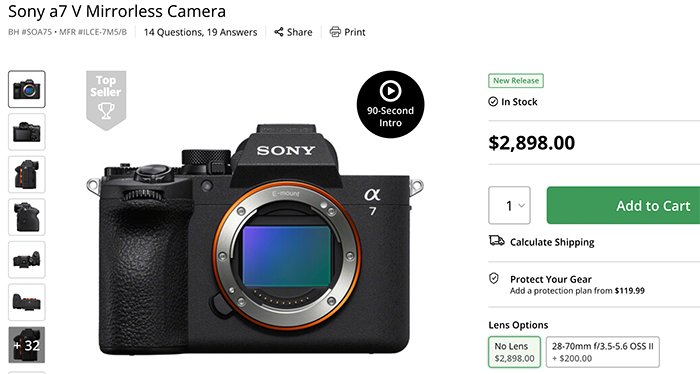
DC.watch: The Sony A7V gives you the Sony A1II/A9III experience for half the price

Sony A7V preorders:
In USA at at BHphoto, Amazon, Adorama, Henrys.
In EU at  Fotokoch, FotoErhardt, Calumet, Foto Köster, WexUK, Clifton, Park UK, Fnac FR.
In Australia at: Camera Pro, Sony Australia.

DC.watch quickly tested the Sony A7V and writes:

It essentially gives mainstream photographers some of the α1 / α9 III intelligence, but at less than half the price.

Here are the bullet points:

  • Model & Positioning
    Sony α7 V is the successor to the α7 IV and sits as Sony’s new all-round full-frame hybrid for photo and video, below the α7R V but with many of its latest technologies.
  • Sensor & Image Quality
    33 MP full-frame partially stacked CMOS sensor (same resolution as α7 IV but much faster readout).
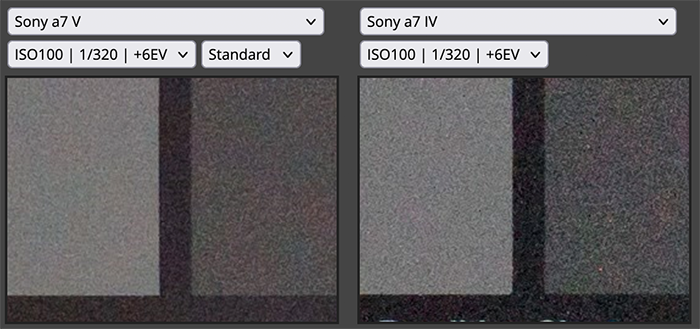
    Aimed to deliver cleaner high-ISO performance with around 16 stops of dynamic range in stills.
  • Speed & Rolling Shutter
    Electronic shutter up to 30 fps with AF/AE tracking, mechanical shutter around 10 fps.
    Much faster readout (≈1/67.5 s) greatly reduces rolling-shutter distortions compared to α7 IV.
  • Autofocus & AI
    BIONZ XR2 processor with dedicated AI unit for subject recognition.
    Tracks people, animals, birds, insects, cars, trains and airplanes with improved reliability over α7 IV.
  • New RAW Features
    Composite RAW: combines multiple frames in-camera for reduced noise or higher dynamic range.
    Single-frame “Extended NR / Extended Hi-Res” via Imaging Edge: deep-learning processing of one RAW file to simulate low-ISO cleanliness or extra detail.
  • Video Capabilities
    4K 60p from full-frame (no crop) and 4K 120p in Super 35 mode, using XAVC S / HS / SI 10-bit 4:2:2 up to ~600 Mbps.
    S-Cinetone and log profiles available, active and dynamic-active electronic stabilization and long, effectively unlimited clip length.
  • Viewfinder & Screen
    3.69M-dot OLED EVF, blackout-free at high burst rates.
    3.2-inch 2.1M-dot rear LCD with 4-axis multi-angle mechanism (tilt + flip) for both stills and video work.
  • Body, Handling & Connectivity
    Body size similar to α7 IV, slightly heavier, with deeper grip and refined controls.
    Two USB-C ports (USB 3.2 10 Gbps + USB 2.0), full-size HDMI, mic and headphone jacks, dual card slots (SD UHS-II / CFexpress Type A compatible).
    Wi-Fi with 2.4/5 GHz and Bluetooth 5.3 for faster transfers and improved app connectivity.
  • Stabilization & Battery
    In-body image stabilization rated around 7.5 stops in the center, improved over α7 IV.
    Uses NP-FZ100 battery; CIPA rating about 630 shots via EVF and 750 via LCD, plus support for USB-PD power/charging.
  • Overall Verdict in the Review
    Reviewer sees α7 V as a “no-compromise” general-purpose camera: big speed and usability upgrade over α7 IV, with strong photo quality and very capable video.
    Recommended as the default Sony full-frame choice for most users who want one camera for everything rather than a specialized high-resolution or cinema-focused body.

The french Phototrend website writes:

Overall verdict: a highly capable, versatile stills camera with class-leading AF and strong performance in most scenarios, but a bit “timid” versus rivals for demanding video shooters.

Spec comparison: Sony A7V vs the Canon R6III…who wins?

Sony A7V preorders:
In USA at at BHphoto, Amazon, Adorama, Henrys.
In EU at  Fotokoch, FotoErhardt, Calumet, Foto Köster, WexUK, Clifton, Park UK, Fnac FR.
In Australia at: Camera Pro, Sony Australia.

Sony A7V vs Canon R6III (full spec comparison on this BH page)

It’s time to make the big discussion: Sony A7V vs Canon R6III. Now one thing has to be made clear: Both are EXCELLENT cameras and nobody should switch system because of “one” camera. But let’s get into the bitty gritty and highlight the differences between the two

1) Sony’s fundamental architectural advantage:

“The Sony A7V uses a more modern, faster sensor architecture (partially stacked vs. Canon’s non-stacked design) and a newer processor with integrated AI. This gives Sony far more headroom for future features added through firmware updates than Canon currently has. In other words, the A7V has significantly greater upward potential that Sony could — and hopefully will — take advantage of. Any missing features today (such as Open Gate) are, at least on paper, well within the camera’s capabilities. Now we just need to push Sony to actually deliver them.”

this is point nearly nobody highlighted: The Canon is based on a regular architecture while Sony has gone all in with a very future proof hardware.

2) Sony is the king of speed:

The devil is always in the detail: While Canon can read out at 13.5ms and the Sony at 15.1ms, the Sony does it in full 14 bit while Canon has to reduce the amount of data with a 12 bit readout. This allows Sony to have an impressive 1+ stop advantage in dynamic range over the Canon! 40fps in lower quality of the Canon is in my opinion not a match for the 30fps 14bit RAW of the Sony.

3) Sony has the edge in still-image quality:

Sixteen stops of dynamic range sounds impressive, and I’m looking forward to proper tests that can confirm whether Sony’s still-image quality now pulls ahead of Canon.

4) Canon wins in video

Canon has 120p uncropped, Open Gate, waveform, false color, 7k. internal RAW recording. Sony’s only advantage is much less overheating issues. Now, Sony has the  margin (speed on the sensor è power on the processor) to improve the video features through future updates. Let’s see if they can close the gap with Canon.

6) Autofocus (to be tested)

Canon has 100% coverage but I suspect Sony will have a more useful, faster and accurate AF system than the Canon. This has to be confirmed via proper testing!

7) Ergonomics and other features

This is mostly a personal preference. The Canon is bigger and maybe easier for some to handle. I personally love the compact size of the Sony A7V. I love their 4 way fully articulating screen. I also found it impressive that the Sony can offer much longer battery life than the Canon

PetaPixel writes:

Before this camera’s announcement, I would have given the best camera of the year to the Canon EOS R6 III. I still might, but the Sony a7 V is easily a contender for this prestigious title.
From a purely photographic standpoint, I think it has minor advantages over the Canon in terms of image quality and focus performance. However, I believe that the Canon is slightly more compelling as a hybrid photo/video product.

Essentially, we have two cameras that are very close in their main specs (33MP resolution, excellent 4K recording), each with its own strengths in specific areas. I feel that Sony has greater potential for growth — but only if Sony recognizes this and is willing to add new features through future firmware updates.

Zach Mayfield believes the Sony FX2 Will be LOVED In 2 years

Zach believes that at first glance, the Sony FX2 might seem like an odd release — but dig a little deeper, and you’ll find one of Sony’s most refined video tools yet. It borrows the trusted 33MP full-frame sensor from the A7 IV and packs it into a compact cinema-style body with top-tier autofocus, impressive IBIS, and a surprisingly useful EVF.

While it lacks 4K 120p and suffers from rolling shutter, it nails the fundamentals: great color, strong codecs, dual native ISO, and excellent ergonomics. The FX2 may not be flashy, but it’s quietly becoming a favorite among solo shooters and hybrid creators.

Sony FX2 at BHphoto, Amazon, Adorama, Fotokoch, FotoErhardt, Calumet, WexUK

And also Sydney Diongzon likes the camera:

Canon R6III vs Sony A7IV comparison!

full spec comparison chart can be found here at BHphoto

I provided ChatGPT with the full Canon R6 III specifications and transcripts from a dozen respected YouTube reviewers, then asked it to create a detailed comparison between the Canon R6 III and the Sony A7 IV.

📸 SENSOR & IMAGE QUALITY
Canon R6 Mark III: 32.5 MP BSI CMOS (non-stacked)
Sony A7 IV: 33 MP BSI CMOS (non-stacked)
Tie – Both sensors are very close in resolution and dynamic range.

⚡ SPEED & BUFFER
Canon: 12 fps (mechanical) / 40 fps (electronic) + RAW pre-capture (≈ 0.5 s before press)
Sony: 10 fps max (mechanical or electronic) (no pre-capture)
Canon wins by far – 4× faster, pre-capture records before you even react, and the new CFexpress Type B slot clears buffers up to 5× faster. Wildlife testers confirmed ≈ 200 RAWs at 40 fps before slowdown.

🎯 AUTOFOCUS & SUBJECT DETECTION
Canon: Dual Pixel AF II + Deep Learning AI, registers faces (10 people / 6 groups), tracks animals, birds, vehicles with face priority. Works down to –6.5 EV.
Sony: Real-Time Tracking AF with human & animal eye AF (+ bird mode since firmware v2.0). Works down to –4 EV.
Canon wins – The new “face registration” and steadier small-subject tracking outperform Sony’s AF in complex scenes.

🪄 STABILIZATION
Canon: up to 8.5 stops IBIS + lens IS sync
Sony: 5.5 stops IBIS
Canon clearly ahead – Stable handheld video even at 600–1200 mm and razor-sharp 1/5 s stills.

🎥 VIDEO CAPABILITIES

Feature Canon R6 III Sony A7 IV
Max Resolution 7K RAW Open Gate → 4K 4K 60 (1.5× crop)
4K 60 / 120 No crop 60 / slight crop 120 Crop 60 / no 120
Bit Depth & Codecs 12-bit RAW / 10-bit C-Log 2 & 3 / HLG / PQ 10-bit 4:2:2 S-Cinetone
HDMI Full-size Full-size
Overheating Moderate (≈ 30 min 4K60 @ 22 °C before 2 bars) Minimal but lower data rates

Canon wins decisively – 7K RAW oversample, C-Log 2/3, waveforms, false color and full HDMI bring it into pro-video territory. Sony is strong for hybrid use but less advanced for video work.

🧠 REAL-WORLD USABILITY
Canon’s field tests highlight its wildlife excellence: fast, accurate AF; reliable tracking on tiny birds; impressive high-ISO sharpness (up to ISO 12 800 clean). Pre-capture proved “game-changing.” Sony feels slower for bursts and less intuitive in AF-mode switching.

🌙 LOW-LIGHT & DYNAMIC RANGE
Both perform well up to ISO 12 800. Canon’s BSI design offers strong detail retention; Sony retains slightly more shadow latitude at base ISO.
Tie / slight Canon edge at high ISO; Sony edge in shadow dynamic range.

📁 MEDIA & CONNECTIVITY
Canon: CF Express Type B + UHS-II SD, full HDMI, mic + headphone, USB-C PD power.
Sony: 2× UHS-II SD (or limited CF Express Type A slot).
Canon wins – faster cards, pro connectors, cleaner tethering.

🔋 BATTERY & THERMALS
Canon: LP-E6P battery, good thermal control (but 7K RAW heats up).
Sony: NP-FZ100 battery = slightly longer photo runtime.
Tie – Canon better for video power, Sony for stills longevity.

💡 ERGONOMICS & BUILD
Both are weather-sealed magnesium bodies. Canon’s grip and menus are praised for comfort; Sony for customization.
Canon favored by most reviewers for handling and workflow.

💰 PRICE (Nov 2025)
Canon R6 III ≈ € 2 799 / $ 2 799
Sony A7 IV ≈ € 1 949 / $ 1 998
Sony wins on price (≈ $ 800 less).

Category Winner
Resolution Tie
Speed / Burst Canon R6 III
Autofocus Canon R6 III
IBIS Canon R6 III
Video Canon R6 III
Dynamic Range Slight Sony
Battery Life Slight Sony
Ergonomics / Ease Canon R6 III
Price / Value Sony A7 IV

🔥 FINAL TAKE
If you’re a hybrid shooter or wildlife / sports photographer, → Canon R6 Mark III is the clear winner: faster bursts, pre-capture, superior AF, 8.5-stop IBIS, and pro-grade video tools.
If you’re budget-conscious or primarily a portrait / studio shooter, → Sony A7 IV remains an excellent alternative with mature color workflow, longer battery life, and slightly better shadow recovery.

Sony’s New Firmware 4.0 Update is here for Sony A1II and A9III: “Tracking +”

PMR-TV writes:

Sony just raised the bar again for AF performance and accuracy with it’s new firmware updates for the Sony A1II and Sony A9III camera bodies. This new 4.0 firmware update packs a new level of AI to assist sports and action photographers so they almost never miss a shot.

Gone are the days when Sony gave us lame firmware updates. Now we really got new remarkable features!