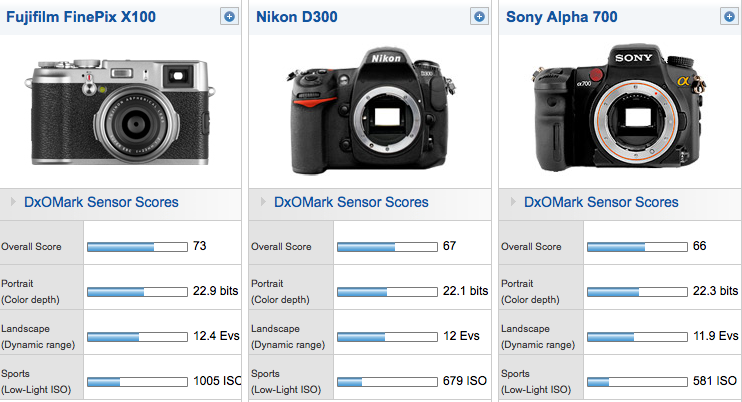






Fuji tweaked Sony sensor is the best in its 12 Megapixel class.

What is the best 12Megapixel APS-C sensor in the world? Drumming…….it’s a Sony sensor on a Fuji camera ![]()
The new Fuji X100 got tested by DxOmark and received an Overall Score of 73 points. No current 12 Megapixel APS-C camera can beat it. By the way, did you knwo the Fuji uses the same Sony A700 sensor? Let’s hope the A77 and all other future cameras will be optimized to squeeze out the full Sony sensor potential!
P.S.: The Fuji X100 with the hybrid viewfinder concepts sells for almost the double original price on eBay (Click here). Sony should take a look into that technology…

jg
2 years ago |According to a recent review on Luminous Landscape one major explanation is that Fuji (like Leica) skipped the AA filter in front of the sensor. This means that the camera will show some moire effects in certain situations. All discussed here: http://www.luminous-landscape.com/reviews/cameras/fuji_x100_follow_up.shtml
Would you like Sony to skip the AA-filter as well?
Daemonius
2 years ago |I would pretty much love having 36 mpix FF without AA filter. Cause anyway, its not that much needed at that resolution. And if you go higher, up to 40 mpix, you dont need AA.
GH
2 years ago |Some are already speculating that the NEX cameras don’t have an AA filter, or it is very weak. I see way more moire with my NEX-5 than I ever saw with my A100/700/900.
Carl
2 years ago |Back in the early 00s, Kodak sold their flagship full frame DSLR with a user removable AA filter. It still has pretty good picture quality by modern standards, at least at low ISOs.
It would be nice if other manufacturers would try that trick, at least with their high resolution models. Not everyone shoots things that will cause moire issues, and for them the filter is pretty much just throwing away resolution for no reason.
Daemonius
2 years ago |That Kodak camera was pretty amazing in lots of things. It has 14 mpix sensor, which is pretty good even for today full-frame. But amazing was ISO range on SLR/n .. starting at ISO 6!
Though, it has few downsides, color shift (kinda present even today on for example Leica M9), color moiré and not-so-good high ISO. But considering age of Kodak dSLRs, its amazing they are usable even today..
Ryan
2 months ago |you got your wish!!
Jochen Schmidt
2 years ago |Actually I think – yes they should skip the AA-filter and do it in software afterwards. This is even more interesting with APS-C sensors of 16 MP and up.
Jerry_R
2 years ago |Of course we would like, like in u43 and M8\M9!
Do you know, that the same M9 RAW opened in different RAW developers (eg. C1, LR\ACR) soft shows different level of moire? So there is still place for improvement for some companies (Adobe) and JPG creating software in camera.
If needed – it is easy to remove moire in post processing (if someone needs bigger enlargements).
Daemonius
2 years ago |Not sure if Im 100% correct, but if you upsample M9 RAW to 24+ mpix, you will get same or higher level of details as 24 mpix camera and as bonuse, you will get rid of moiré.
Adam Maas
2 years ago |Given that C1 is immune to luminance moire as it uses vectorized luminance data, differing levels of moire between converters is a given once you put c1 in the comparison.
Note you still can get colour moire in C1, just not luminance.
pancanikonpus
2 years ago |This is very really surprising. But i think this bad idea because you gain the score at the same time you gain the moire. 73 marks vs Moire, which are more important?
Sky_walker
2 years ago |73 marks any time, night and day.
I can remove moire in Photoshop.
But I cannot add missing details in photoshop that were removed by blurring effect of AA filter.
Even if Photoshop result would be bit worse than AA filter – I still would get rid of AA entirely.
But that’s just me.
pancanikonpus
2 years ago |If the moire found in video will be troublesome. Post processing is really take time if have lot still/video to process. I would rather choose to less moire, less processing time. In the end, logically only one thing we are about – “quality” while can save our time.
so you are choosing this because
1.If moire, post processing
2.If no moire, you gain still detail
Daemonius
2 years ago |Well, cameras are for photos.. not movies, as would some manufacturers want us to believe. For me, last true camera is probably A900.
pancanikonpus
2 years ago |“Camera for still not movies” are 20th century business mind set. 21st century business strategy, HDSLR segment is a must. Any compact camera today come with FHD video, Sony also come with 28MBPS bitrate.
User can now decide to go for Pro camcorder or otherwise buy HDSLR which is cheap and nice in shooting FHD video.
Sky_walker
2 years ago |ROTFL – “User can now decide to go for Pro camcorder or otherwise buy HDSLR” – this made me laugh!
HDSLRs are good only if you look for shallow depth of field – for everything else the camcoder wins. Moire, colors, rolling shutter, AF, picture quality, etc. etc.
HDSLRs win in price to depth of field factor, but not in price to video quality.
“If the moire found in video will be troublesome.” – Moire in HDSLR videos exists no matter if AA filter is there, or is not. Did you ever seen the 5D MKII videos? Check this: http://www.youtube.com/watch?v=Lgw90AYbaYM&feature=player_embedded#at=13
RB
2 years ago |Be patient with him…. He just upgraded from CyberShot and doesn’t know the difference between still photography and motion picture yet…
Really Pancanonikonpus, still and motion picture are two totally different worlds. Starting from required camera ergonomics over requirements to image recording and image quality, requirements to lenses, requirements to image postprocessing, etc. Things which are unimportant in the one world might be crucial in the other and vice versa. The only overlapp is that both cams have a lens and an image recording device. And that’s all. Therefore it doesn’t make any sense at all to combine still and motion picture recording in one device. — Except for consumers coming from the point-and-shot market and want to have the same “features” in their (first) DSLR.
SVOR
2 years ago |Are you sure you can remove moire with post processing? I think it is theoretically impossible. Moire is effectively aliasing. That means that spatial frequencies above Nyquist will become represented as low spatial frequencies which can not be removed by post processing as there is no way to separate this effect from authentic information. I agree that moire in real life images is rare especially as sensors increasingly have more resolution than many lenses can deliver but if you do get moire you can’t be sure that you can remove it. I would not buy a camera without an AA filter.
Go here:-
http://en.wikipedia.org/wiki/Spatial_anti-aliasing
to get the theory and look here:-
http://www.dpreview.com/reviews/kodakslrc/page20.asp
to see what the Kodak DCS Pro SLR/c did with real-world images of text printed on paper.
RB
2 years ago |In principle you’re right. BUT: There are ways to deal with it. I don’t know which technique is applied, but I can think of several ways right now:
1. Remember that each pixel consists in fact of four pixels in the Bayer Pattern. So, while demosaicing, you can evaluate the information which is phase-shifted by one (“sub-”)pixel.
2. As you know the actual sensor pattern, you can deconvolute the beating and generate a non-periodic pattern as a kind of “smart-antialiasing”
3. You can simply delete the moiree pattern — and replace it by something else.
SVOR
2 years ago |Good luck with that. Assuming e.g. a luminance only image (represented by components in R, G & B) then you can in theory reconstruct additional sample sites from the Bayer pattern which might improve the spatial response and REDUCE the moire/aliasing. Option 2 might work if the beat pattern is regular but I suspect most will opt for your option 3.
In the end it is a personal choice which is better, AA filter or no AA filter but I think Leica betrayed a degree of naivity in the M8 design when the chose not to include the filters used by other manufacturers. Maybe they were badly advised by the sensor suppliers?
roni
2 years ago |good as the nikon d90 3 years ago
Daemonius
2 years ago |Which has Sony made sensor aswell.
(but designed by Nikon)
Adam Maas
2 years ago |Same sensor in fact, just with Nikon-specified ADC’s and sensor toppings. Sony only has one 12MP CMOS sensor and it;s been used widely (same basic sensor is in the Leica X1 as well)
Pentax runs a close second in DXOMark ratings with the K-x and K-r both coming in at 72, but in the real world both of those outperform the D90,especially at high ISO’s. I’m rather wondering how the D90 got a better high ISO rating than the K-x when the K-x’s real-world performance exceeds the D90′s by a fair margin (around a stop better at ISO 6400). Of course DXOMark’s high ISO ratings do not translate well into real-world performance.
Daemonius
2 years ago |Maybe they removed some points for K-x and K-r for smoothing higher ISO. They wrote some article about it. If you check K-x results on DxO, they have link down under SNR chart.
From what I saw, K-r has pretty good output at higher ISO. Maybe really better than D90.
Irfan
2 years ago |Designed by Sony. Nikon designed sensor are used by Nikon only. Sony designed sensor are sold to Nikon, Pentax, Leica, and now Fuji. Nikon has nothing to do with designing these sensors that are Sony’s property.
Hannu Siika-aho
2 years ago |Yes, Nikon D90 gets the same 73 points and it was made 2008. Tells something about their know-how…
Zonkie
2 years ago |I don’t think it has to do with the AA filter. If anything, an AA filter removes noise (and detail), so it could give a slightly higher score with an AA filter. Besides, you can compare sensors from the Olympus E-620 (with a strong AA filter) with one from the E-5 (same sensor, very weak AA filter) and they perform about the same.
The sensor of the Fuji X100 performs about the same as the one in the Pentax K-x, which is also from Sony, also 12 MP and does have AA filter.
PhotoNut
2 years ago |Geez, the A700 is what, four years old? There are newer Sony 12mp CMOS sensors like that used on the D90 and D300s so why use such old models to make your point.
Daemonius
2 years ago |Only D300/s is Sony design and manufacturing, D90 is Nikon desing and Sony manufacturing. I suspect that Fuji X100 uses some postprocessing to get clean image..
Adam Maas
2 years ago |Umm, no. The D90 and D300 share essentially the same sensor, the difference is the number of output channels and the clock rate (the D300/D300s sensor has twice the output channels and a higher clock, leading to lower high ISO performance due to extra heat from being run faster).
The only Nikon-designed 12MP sensors are in the D3/D3s/D700 and the D2X/D2Xs. The D90 and D300 sensors are a Sony design modified to Nikon spec.
The A700 sensor, also used in the Pentax K-x/K-r, differs from the Nikon implementation mostly in the output configuration as Sony prefers the per-column output rather than a channelized output. I’d suspect the X100 and Leica X1 also use the Sony-style output.
Daemonius
2 years ago |Well, I didnt know that.
Thanks for info, will remember that for future. I was aware of D3 and others, but I thought D90 was same case. Nice explanation btw.
Irfan
2 years ago |D90 (like D5000) did a mild RAW NR. That’s why it was overrated on dxomark (rated higher than D300s that was newer than D90 but doesn’t do RAW NR).
Irfan
2 years ago |Sorry Nikon doesn’t have crap to do with D90 sensor. D90 was overrated just because of RAW NR. You can clearly see RAW NR artifacts in D90 RAW files. K-x, which was only 1 point lower than D90, uses the same sensor. Both have Sony sensor.
Petr Klapper
2 years ago |Reminds me of Nikon D3X using the 24mpix Sony sensor (Same as in A850/A900) while making better images too..
Daemonius
2 years ago |In real world terms, IQ from D3X isnt better than A900. Theres even comparsion on net, which shows its basically same, except for price. Plus A900 has better color accuracy and tiny bit more details at expense of having bit more noise (different CFA and I guess their EXMOR technology).
pancanikonpus
2 years ago |What is the score of Dxo if X100 vs a300? I used to own a300 i think is 14mp camera but the performance in term of low light processing just very bad. i wonder a300 will perform lower than this x100…
I seen many ppl say the same thing. DXO score does not match to actual performance.
Almond
2 years ago |OMG, I feel like I need to go out a buy a $1200 Fuji because it outscored my A700. No!!!!!!!!!!!
pancanikonpus
2 years ago |Sound worry everyone using Sony sensor. The future will rely on Samsung to compete with Sony.
Daemonius
2 years ago |Thats pretty much true, only exceptions are MF and Leicas (though future Leica will be probably Sony too).
jg
2 years ago |Sony, Samsung … but remember also Canon, Panasonic and Nikon’s FX-sensors (can’t remember right now who makes them).
RB
2 years ago |Sony.
jg
2 years ago |Sorry.
Hannu Siika-aho
2 years ago |Nope. Nikon designs the sensors of their high-end FX cameras, i.e., D3, D3s and D700. You can find this info by googling it. The mid range and entry level sensors are by Sony, but they are modified by Nikon. There is a exception to this and that is Nikon’s D3100 which has a Nikon designed sensor.
EG
2 years ago |Where did you get that Fuji’s X100 sensor is from Sony? I read today Valentin Sama’s article about the Fuji (in spanish) and he sais that the sensor could be from Sony or Toshiba… for him it’s not clear:
http://www.dslrmagazine.com/pruebas/pruebas-tecnicas/fujifilm-x100-rendimiento-sensor-raw.html
pancanikonpus
2 years ago |Sony bought Toshiba sensor factory
EG
2 years ago |Ok, that’s a good explanation
Thanks!
EG
2 years ago |Today I read a new article that says the Fuji’s X100 camera sensor could be from Fuji!
http://www.google.com/reader/view/?hl=es&source=mmm-es#stream/feed%2Fhttp%3A%2F%2Fwww.fotoactualidad.com%2Ffeeds%2Fposts%2Fdefault
So, finally I have always my doubts.
EG
2 years ago |Sorry… here the direct link: http://www.fotoactualidad.com/2011/04/sensor-de-la-finepix-x100-fabricado-por.html?utm_source=feedburner&utm_medium=feed&utm_campaign=Feed%3A+FotoActualidad+%28Foto+Actualidad%29
Sahaja
2 years ago |Practically the X100 sensor cannot be tested apart from the lens and the processor it is combined with. Do these results really show a “better” sensor or only a better combination?